
Understanding binary number systems is fundamental in the field of computer science and digital electronics. One of the most commonly used representations is the 2's Complement Converter, which is essential for performing arithmetic operations in binary. This system allows for efficient handling of both positive and negative numbers using a fixed number of bits. In this post, we will delve into the intricacies of the 2's Complement Converter, its significance, and how to convert binary numbers using this method.
What is 2’s Complement?
The 2’s Complement system is a mathematical representation used to encode negative numbers in binary form. It is widely used in digital circuits and computer systems because it simplifies arithmetic operations, particularly subtraction. In this system, the most significant bit (MSB) represents the sign of the number: 0 for positive and 1 for negative.
Understanding the 2’s Complement System
To understand the 2’s Complement Converter, it’s important to grasp the basics of binary numbers and how they are represented. A binary number is a sequence of 0s and 1s. In the 2’s Complement system, the value of a binary number is determined by its position and the sign bit.
For example, consider an 8-bit binary number. The leftmost bit is the sign bit, and the remaining seven bits represent the magnitude of the number. If the sign bit is 0, the number is positive. If the sign bit is 1, the number is negative.
Converting Positive Numbers to 2’s Complement
Converting a positive number to its 2’s Complement representation is straightforward. You simply write the binary representation of the number, ensuring the sign bit is 0.
For example, to convert the decimal number 5 to an 8-bit 2's Complement number:
- Write the binary representation of 5: 00000101.
- Ensure the sign bit is 0: 00000101.
Converting Negative Numbers to 2's Complement
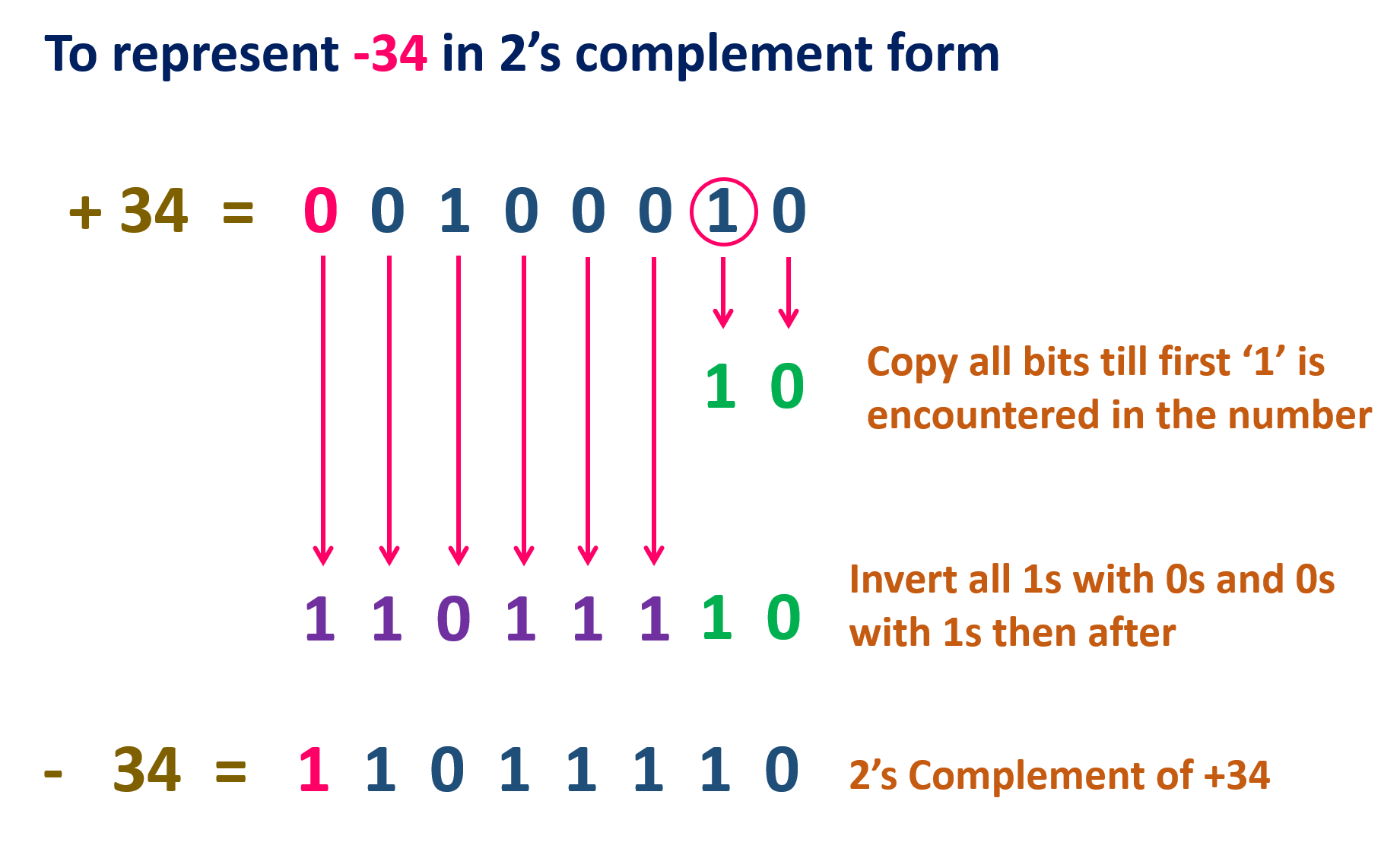
Converting a negative number to its 2's Complement representation involves a few more steps. The process is as follows:
- Find the binary representation of the absolute value of the number.
- Invert all the bits (change 0s to 1s and 1s to 0s).
- Add 1 to the least significant bit (LSB) of the inverted number.
For example, to convert the decimal number -5 to an 8-bit 2's Complement number:
- Find the binary representation of 5: 00000101.
- Invert all the bits: 11111010.
- Add 1 to the LSB: 11111010 + 1 = 11111011.
So, the 2's Complement representation of -5 is 11111011.
Performing Arithmetic Operations
One of the key advantages of the 2’s Complement system is its ability to simplify arithmetic operations. Addition and subtraction can be performed using the same circuitry, making it efficient for digital systems.
For example, to add two 2's Complement numbers:
- Align the numbers by their sign bits.
- Perform binary addition.
- Handle any overflow or underflow as necessary.
For subtraction, you can use the 2's Complement of the subtrahend (the number being subtracted) and add it to the minuend (the number from which you are subtracting).
Example of 2’s Complement Addition
Let’s consider an example of adding two 8-bit 2’s Complement numbers: 5 and -3.
- The 2’s Complement representation of 5 is 00000101.
- The 2’s Complement representation of -3 is 11111101.
Perform binary addition:
| 00000101 | + | 11111101 | = | 11111010 |
The result, 11111010, is the 2's Complement representation of 2. This shows that 5 + (-3) = 2.
Example of 2’s Complement Subtraction
Now, let’s consider subtracting -3 from 5 using the 2’s Complement system.
- The 2’s Complement representation of 5 is 00000101.
- The 2’s Complement representation of -3 is 11111101.
To subtract -3 from 5, add the 2's Complement of -3 to 5:
| 00000101 | + | 00000011 | = | 00000100 |
The result, 00000100, is the 2's Complement representation of 8. This shows that 5 - (-3) = 8.
💡 Note: When performing arithmetic operations, always ensure that the numbers are aligned by their sign bits to avoid errors.
Applications of 2’s Complement
The 2’s Complement system is widely used in various applications, including:
- Digital Circuits: Simplifies the design of arithmetic logic units (ALUs) by using the same circuitry for addition and subtraction.
- Microprocessors: Efficiently handles arithmetic operations, making it a standard in modern CPU design.
- Embedded Systems: Used in microcontrollers and other embedded devices for efficient arithmetic operations.
Advantages of 2’s Complement
The 2’s Complement system offers several advantages:
- Simplicity: Simplifies the design of arithmetic circuits by using the same logic for addition and subtraction.
- Efficiency: Reduces the complexity of handling negative numbers, making it faster and more efficient.
- Range: Provides a symmetric range of positive and negative numbers, which is useful in many applications.
Limitations of 2’s Complement
Despite its advantages, the 2’s Complement system has some limitations:
- Overflow: Can result in overflow errors when the result exceeds the maximum representable value.
- Complexity in Multiplication: Multiplication and division operations can be more complex compared to other systems.
- Fixed Bit Length: The range of representable numbers is fixed by the number of bits, which can be a limitation in some applications.
💡 Note: Always consider the range of numbers and potential overflow issues when using the 2's Complement system.
In conclusion, the 2’s Complement Converter is a crucial concept in digital electronics and computer science. It provides an efficient way to represent and manipulate both positive and negative numbers using a fixed number of bits. Understanding how to convert numbers to and from 2’s Complement and perform arithmetic operations is essential for anyone working in these fields. By mastering this system, you can design more efficient and reliable digital circuits and systems.
Related Terms:
- 2s complement calculator with steps
- hex to 2s complement converter
- two's complement calculator
- binary to 2s complement converter
- 1s complement and 2s calculator
- two's complement