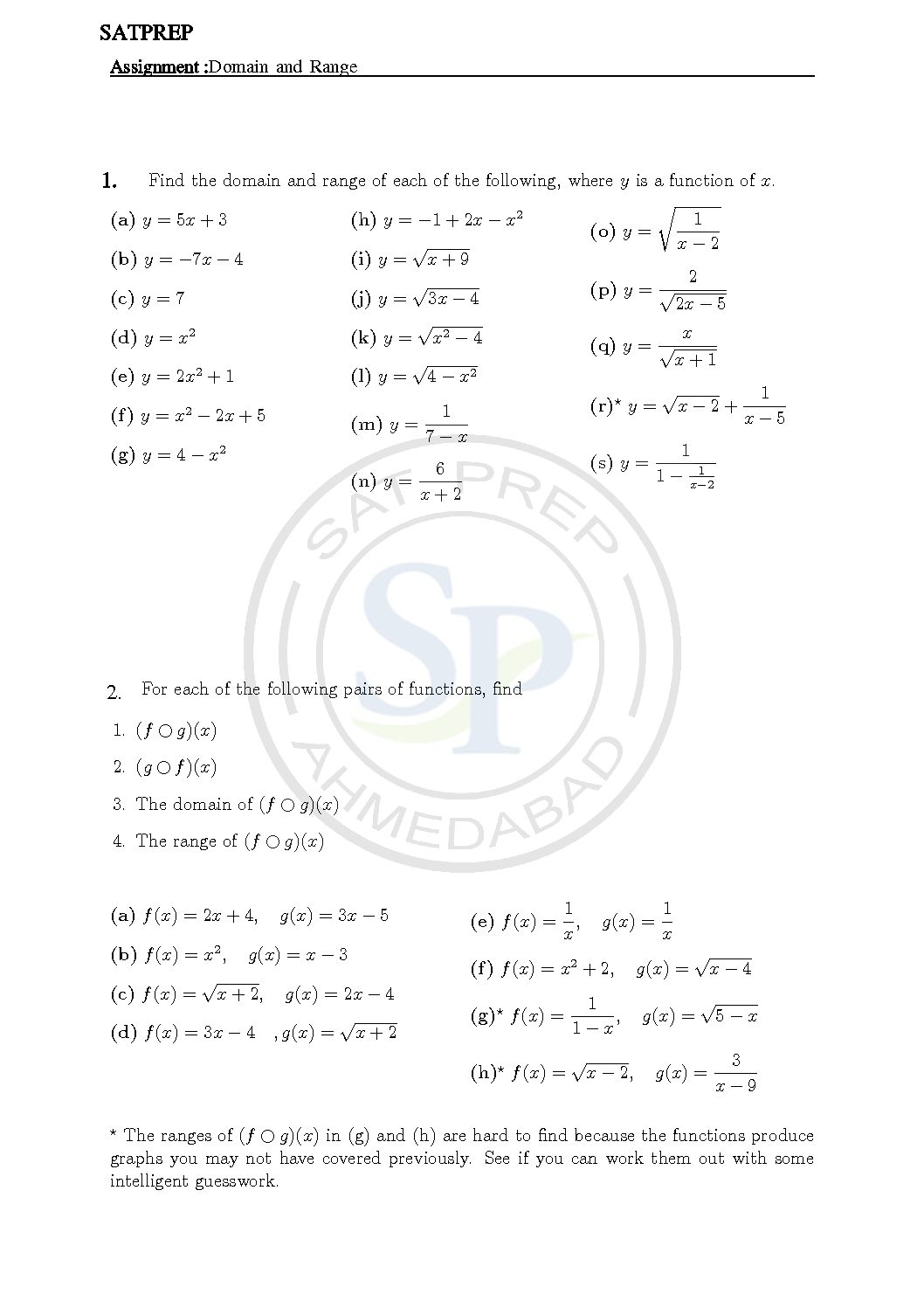

Understanding the concept of a composition function domain is crucial for anyone delving into the world of mathematics, particularly in the realms of calculus and abstract algebra. A composition function domain refers to the set of all possible inputs for which a composite function is defined. This concept is fundamental in ensuring that mathematical operations are valid and meaningful. By exploring the composition function domain, we can gain insights into the behavior of functions and their interactions.
Understanding Composition of Functions
Before diving into the composition function domain, it's essential to grasp the basics of function composition. Function composition involves combining two or more functions to create a new function. If we have two functions, f and g, the composition of f and g, denoted as f ∘ g, is defined as:
f ∘ g(x) = f(g(x))
This means that the output of g becomes the input for f. For the composition to be valid, the output of g must be within the domain of f. This is where the composition function domain comes into play.
Determining the Composition Function Domain
To determine the composition function domain of f ∘ g, we need to consider the domains of both f and g. The steps involved are as follows:
- Identify the domain of g, denoted as Dom(g).
- Identify the domain of f, denoted as Dom(f).
- Determine the range of g, denoted as Ran(g).
- The composition function domain of f ∘ g is the set of all x in Dom(g) such that g(x) is in Dom(f).
In mathematical notation, this can be expressed as:
Dom(f ∘ g) = {x ∈ Dom(g) | g(x) ∈ Dom(f)}
Let's illustrate this with an example.
Example: Finding the Composition Function Domain
Consider the functions f(x) = √x and g(x) = x + 1.
- The domain of f is [0, ∞) because the square root function is defined for non-negative numbers.
- The domain of g is all real numbers, R.
- The range of g is also all real numbers, R.
To find the composition function domain of f ∘ g, we need to ensure that g(x) is in the domain of f. This means:
g(x) = x + 1 ≥ 0
Solving for x, we get:
x ≥ -1
Therefore, the composition function domain of f ∘ g is [-1, ∞).
💡 Note: It's important to note that the composition function domain can be different from the domains of the individual functions. Always ensure that the output of the inner function is within the domain of the outer function.
Properties of Composition Function Domain
The composition function domain has several key properties that are important to understand:
- Non-emptiness: The composition function domain is non-empty if and only if the range of the inner function intersects with the domain of the outer function.
- Inclusion: The composition function domain is always a subset of the domain of the inner function.
- Transitivity: If f ∘ g and g ∘ h are defined, then f ∘ (g ∘ h) is also defined, and its composition function domain is a subset of the composition function domain of g ∘ h.
These properties help in understanding the behavior of composite functions and their domains.
Applications of Composition Function Domain
The concept of composition function domain has wide-ranging applications in various fields of mathematics and beyond. Some of the key areas where it is applied include:
- Calculus: In calculus, understanding the composition function domain is crucial for differentiating and integrating composite functions. The chain rule, for example, relies on the composition of functions.
- Abstract Algebra: In abstract algebra, the composition function domain is used to define and study group homomorphisms and other algebraic structures.
- Computer Science: In computer science, the composition function domain is used in the design of algorithms and data structures, particularly in the context of function composition and recursion.
- Engineering: In engineering, the composition function domain is used in modeling and analyzing systems that involve multiple functions, such as control systems and signal processing.
By understanding the composition function domain, we can ensure that our mathematical models and computations are valid and meaningful.
Common Mistakes and Pitfalls
When working with the composition function domain, there are several common mistakes and pitfalls to avoid:
- Ignoring the Domain of the Outer Function: One of the most common mistakes is forgetting to check if the output of the inner function is within the domain of the outer function.
- Assuming the Composition Function Domain is the Same as the Domain of the Inner Function: The composition function domain is not always the same as the domain of the inner function. Always verify the intersection of the range of the inner function and the domain of the outer function.
- Overlooking the Range of the Inner Function: The range of the inner function plays a crucial role in determining the composition function domain. Ensure that you accurately determine the range of the inner function.
By being aware of these pitfalls, you can avoid common errors and ensure accurate results.
Advanced Topics in Composition Function Domain
For those interested in delving deeper into the composition function domain, there are several advanced topics to explore:
- Inverse Functions: Understanding the composition function domain of inverse functions and how it relates to the original functions.
- Multiple Compositions: Exploring the composition function domain when multiple functions are composed together.
- Partial Functions: Investigating the composition function domain for partial functions, where the domain is not the entire set of possible inputs.
These advanced topics provide a deeper understanding of the composition function domain and its applications.
To further illustrate the concept, let's consider a table that summarizes the composition function domain for different types of functions:
| Function Type | Example Functions | Composition Function Domain |
|---|---|---|
| Linear Functions | f(x) = ax + b, g(x) = cx + d | All real numbers, R |
| Quadratic Functions | f(x) = ax2 + bx + c, g(x) = dx2 + ex + f | Depends on the specific functions |
| Exponential Functions | f(x) = ax, g(x) = bx | All real numbers, R |
| Logarithmic Functions | f(x) = log(x), g(x) = log(x) | (0, ∞) |
This table provides a quick reference for the composition function domain of different types of functions.
💡 Note: The composition function domain can vary significantly depending on the specific functions involved. Always verify the domain and range of each function to ensure accurate results.
In conclusion, the composition function domain is a fundamental concept in mathematics that plays a crucial role in understanding the behavior of composite functions. By carefully determining the composition function domain, we can ensure that our mathematical models and computations are valid and meaningful. This concept has wide-ranging applications in various fields, from calculus and abstract algebra to computer science and engineering. Understanding the composition function domain is essential for anyone working with functions and their compositions.
Related Terms:
- function operations and compositions
- domain of composite function example
- domain of composed functions
- composition of functions graph
- domain of composite functions practice
- composite functions and domains