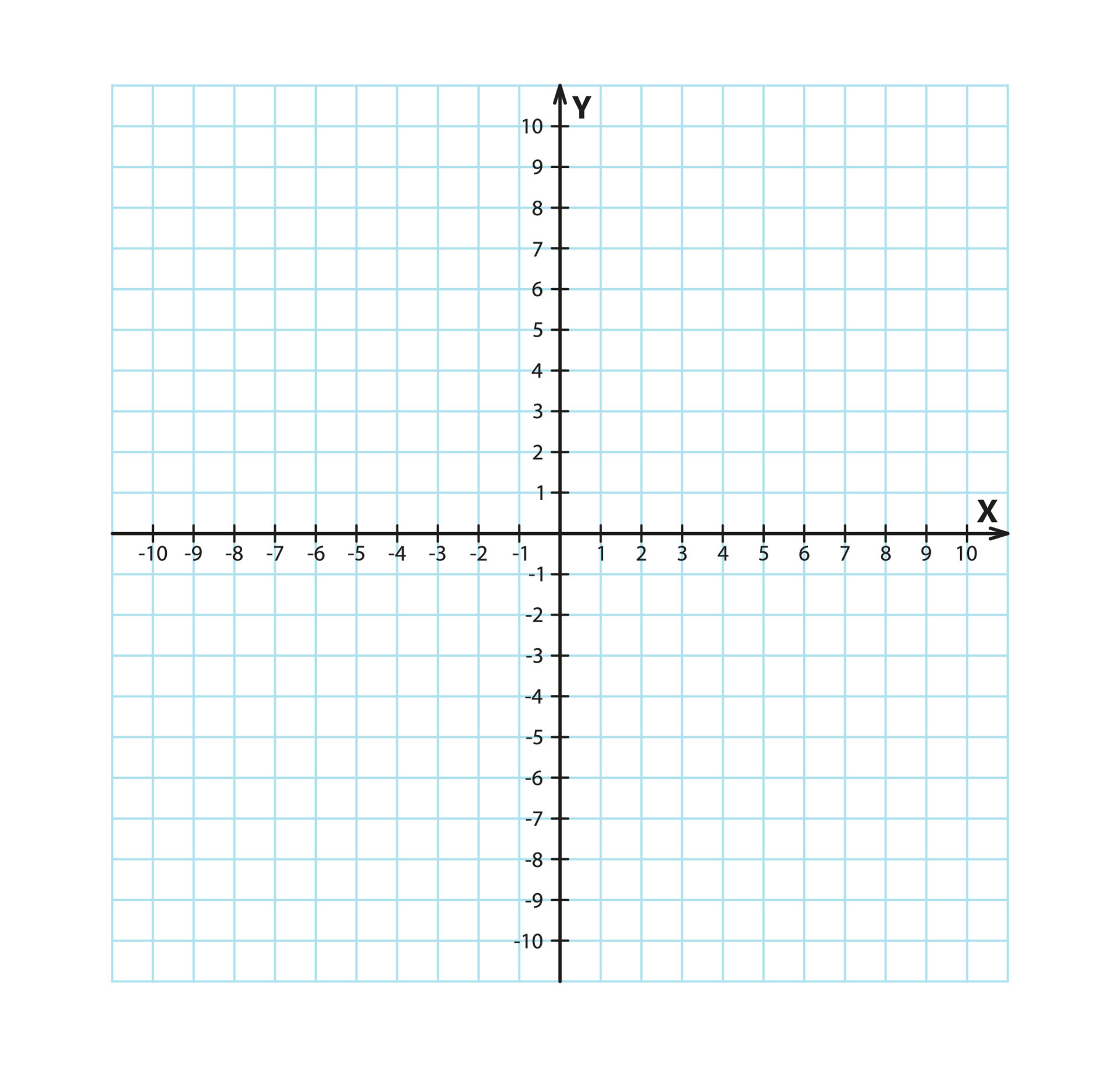

Understanding the coordinate plane is fundamental in mathematics, particularly in geometry and algebra. The coordinate plane, also known as the Cartesian plane, is a two-dimensional surface defined by two perpendicular axes: the horizontal axis (x-axis) and the vertical axis (y-axis). These axes intersect at a point called the origin, which serves as the reference point for locating any other point on the plane. The coordinate plane define the position of any point using an ordered pair of numbers (x, y), where x represents the horizontal distance from the origin and y represents the vertical distance.
Understanding the Coordinate Plane
The coordinate plane is a graphical representation that allows us to visualize and solve problems involving two variables. It is named after René Descartes, who introduced the concept of using algebraic methods to solve geometric problems. The coordinate plane is divided into four quadrants by the x-axis and y-axis. Each quadrant has specific characteristics:
- Quadrant I: Both x and y are positive.
- Quadrant II: x is negative, y is positive.
- Quadrant III: Both x and y are negative.
- Quadrant IV: x is positive, y is negative.
To better understand the coordinate plane, let's delve into the components that define it:
The Axes
The coordinate plane is defined by two perpendicular lines, the x-axis and the y-axis. The x-axis runs horizontally, while the y-axis runs vertically. These axes intersect at the origin, which is the point (0, 0). The axes are essential for locating points on the plane. The x-axis is often referred to as the horizontal axis, and the y-axis as the vertical axis.
The Origin
The origin is the point where the x-axis and y-axis intersect. It is denoted by the coordinates (0, 0). The origin serves as the reference point for all other points on the coordinate plane. Any point on the plane can be located relative to the origin using its x and y coordinates.
Coordinates
Coordinates are ordered pairs of numbers (x, y) that define the position of a point on the coordinate plane. The first number, x, represents the horizontal distance from the origin, and the second number, y, represents the vertical distance. For example, the point (3, 4) is located 3 units to the right of the origin and 4 units above the origin.
Quadrants
The coordinate plane is divided into four quadrants by the x-axis and y-axis. Each quadrant has specific characteristics based on the signs of the x and y coordinates:
| Quadrant | x-coordinate | y-coordinate |
|---|---|---|
| I | Positive | Positive |
| II | Negative | Positive |
| III | Negative | Negative |
| IV | Positive | Negative |
Understanding the quadrants is crucial for plotting points and interpreting graphs on the coordinate plane.
Plotting Points on the Coordinate Plane
Plotting points on the coordinate plane involves locating the point based on its x and y coordinates. Here are the steps to plot a point:
- Identify the x-coordinate and move horizontally from the origin.
- Identify the y-coordinate and move vertically from the origin.
- Mark the point where the horizontal and vertical lines intersect.
For example, to plot the point (2, 3):
- Move 2 units to the right from the origin along the x-axis.
- Move 3 units up from the origin along the y-axis.
- Mark the point where these two lines intersect.
📌 Note: Remember that the x-coordinate is always plotted first, followed by the y-coordinate.
Graphing Equations on the Coordinate Plane
Graphing equations on the coordinate plane involves plotting points that satisfy the equation and connecting them to form a graph. Here are the steps to graph a linear equation:
- Choose several values for x and solve for y using the equation.
- Plot the points (x, y) on the coordinate plane.
- Connect the points with a straight line.
For example, to graph the equation y = 2x + 1:
- Choose values for x, such as -1, 0, 1, and 2.
- Solve for y using the equation:
- For x = -1, y = 2(-1) + 1 = -1
- For x = 0, y = 2(0) + 1 = 1
- For x = 1, y = 2(1) + 1 = 3
- For x = 2, y = 2(2) + 1 = 5
- Plot the points (-1, -1), (0, 1), (1, 3), and (2, 5) on the coordinate plane.
- Connect the points with a straight line.
📌 Note: Ensure that the points are plotted accurately to get a precise graph.
Applications of the Coordinate Plane
The coordinate plane has numerous applications in various fields, including mathematics, physics, engineering, and computer graphics. Some of the key applications include:
- Geometry: The coordinate plane is used to define shapes, calculate distances, and determine angles.
- Algebra: It is used to graph equations, solve systems of equations, and analyze functions.
- Physics: The coordinate plane is used to represent motion, forces, and other physical quantities.
- Engineering: It is used in design, modeling, and simulation of structures and systems.
- Computer Graphics: The coordinate plane is used to create and manipulate images and animations.
The coordinate plane is a versatile tool that enhances our ability to visualize and solve problems in various disciplines.
In conclusion, the coordinate plane is a fundamental concept in mathematics that allows us to visualize and solve problems involving two variables. By understanding the axes, origin, coordinates, and quadrants, we can effectively plot points and graph equations. The coordinate plane has wide-ranging applications in mathematics, physics, engineering, and computer graphics, making it an essential tool for students and professionals alike. Mastering the coordinate plane opens up a world of possibilities for solving complex problems and gaining deeper insights into various fields.
Related Terms:
- coordinates definition math
- coordinate plane definition math
- quadrants coordinate plane definition
- coordinate plane definition short
- coordinate plane examples
- coordinate plane definition geometry