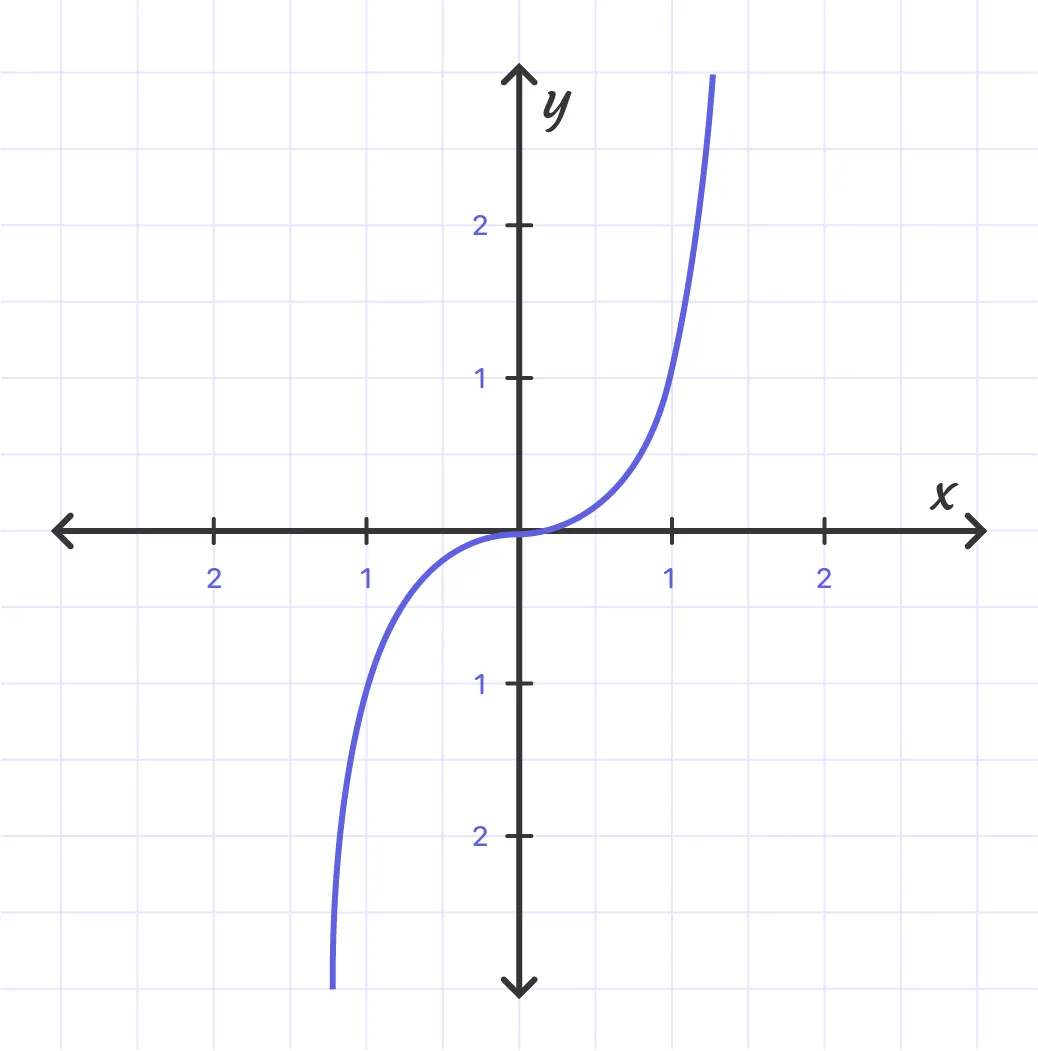

Cubic graph functions are a fundamental concept in mathematics, particularly in the field of algebra and calculus. These functions are polynomial functions of degree three, meaning they have the form f(x) = ax³ + bx² + cx + d, where a, b, c, and d are constants and a ≠ 0. Understanding cubic graph functions is crucial for various applications, from physics and engineering to economics and computer graphics.
Understanding the Basics of Cubic Graph Functions
Cubic graph functions are characterized by their degree, which is the highest power of the variable x. In the case of cubic functions, the highest power is three. This degree determines the general shape and behavior of the graph. Cubic functions can have up to three real roots, which are the points where the graph intersects the x-axis.
The general form of a cubic function is:
f(x) = ax³ + bx² + cx + d
Where:
- a is the leading coefficient, which determines the direction in which the ends of the graph point.
- b, c, and d are constants that affect the shape and position of the graph.
Cubic functions can exhibit a variety of shapes, including:
- A single turning point (inflection point).
- Two turning points (local maximum and local minimum).
- Three real roots.
Graphing Cubic Functions
Graphing cubic functions involves plotting points and understanding the behavior of the function as x approaches positive and negative infinity. Here are the steps to graph a cubic function:
- Identify the leading coefficient a to determine the end behavior of the graph. If a is positive, the graph will rise to the right and fall to the left. If a is negative, the graph will fall to the right and rise to the left.
- Find the roots of the function by setting f(x) = 0 and solving for x. These roots are the x-intercepts of the graph.
- Determine the y-intercept by evaluating f(0).
- Find the vertex or vertices of the function by taking the derivative f'(x) and setting it to zero. Solve for x to find the critical points.
- Evaluate the function at the critical points to find the local maxima and minima.
- Plot the points and sketch the graph, ensuring it reflects the end behavior and passes through the identified points.
📝 Note: Use graphing calculators or software to verify your sketches and gain a better understanding of the function's behavior.
Key Features of Cubic Graph Functions
Cubic graph functions have several key features that distinguish them from other polynomial functions:
- End Behavior: The end behavior of a cubic function is determined by the leading coefficient a. If a is positive, the graph will rise to the right and fall to the left. If a is negative, the graph will fall to the right and rise to the left.
- Roots: Cubic functions can have up to three real roots, which are the points where the graph intersects the x-axis.
- Turning Points: Cubic functions can have up to two turning points, which are the local maxima and minima of the function.
- Inflection Point: Cubic functions can have an inflection point, where the concavity of the graph changes.
Applications of Cubic Graph Functions
Cubic graph functions have numerous applications in various fields. Some of the most notable applications include:
- Physics: Cubic functions are used to model the motion of objects under constant acceleration, such as projectiles.
- Engineering: Cubic functions are used in structural analysis to model the deflection of beams and other structural elements.
- Economics: Cubic functions are used to model economic phenomena, such as supply and demand curves, and to analyze market equilibrium.
- Computer Graphics: Cubic functions are used in computer graphics to model curves and surfaces, such as Bezier curves and splines.
Examples of Cubic Graph Functions
Let's explore a few examples of cubic graph functions to better understand their behavior and properties.
Example 1: f(x) = x³
This is the simplest form of a cubic function. The graph of f(x) = x³ passes through the origin and has a single turning point at (0, 0). The function is increasing for all x and has no local maxima or minima.
Example 2: f(x) = x³ - 3x² + 3x - 1
This cubic function can be factored as f(x) = (x - 1)³. The graph has a single root at x = 1 and a turning point at (1, 0). The function is increasing for x < 1 and decreasing for x > 1.
Example 3: f(x) = x³ - 6x² + 9x + 1
This cubic function has three real roots, which can be found by solving the equation x³ - 6x² + 9x + 1 = 0. The graph has two turning points and exhibits a more complex behavior compared to the previous examples.
Analyzing Cubic Graph Functions
Analyzing cubic graph functions involves understanding their behavior, finding their roots, and determining their critical points. Here are some key steps to analyze a cubic function:
- Identify the leading coefficient a to determine the end behavior of the graph.
- Find the roots of the function by setting f(x) = 0 and solving for x.
- Determine the y-intercept by evaluating f(0).
- Find the critical points by taking the derivative f'(x) and setting it to zero. Solve for x to find the critical points.
- Evaluate the function at the critical points to find the local maxima and minima.
- Analyze the concavity of the function by taking the second derivative f''(x) and determining where it is positive or negative.
📝 Note: Use calculus to find the critical points and analyze the concavity of the function. This will help you understand the behavior of the function more deeply.
Special Cases of Cubic Graph Functions
There are several special cases of cubic graph functions that are worth noting:
- Monotonic Cubic Functions: These are cubic functions that are either always increasing or always decreasing. An example is f(x) = x³, which is always increasing.
- Cubic Functions with Repeated Roots: These are cubic functions that have a repeated root. An example is f(x) = (x - 1)³, which has a repeated root at x = 1.
- Cubic Functions with Complex Roots: These are cubic functions that have complex roots. An example is f(x) = x³ + 1, which has one real root and two complex roots.
Transformations of Cubic Graph Functions
Cubic graph functions can be transformed by applying various operations, such as translations, reflections, and scalings. These transformations can help you understand the behavior of the function and its graph. Here are some common transformations:
- Vertical Translation: Adding or subtracting a constant k to the function f(x) results in a vertical translation of the graph by k units.
- Horizontal Translation: Replacing x with x - h in the function f(x) results in a horizontal translation of the graph by h units.
- Reflection: Replacing x with -x in the function f(x) results in a reflection of the graph across the y-axis.
- Scaling: Multiplying the function f(x) by a constant a results in a vertical scaling of the graph by a units. Multiplying x by a constant a results in a horizontal scaling of the graph by 1/a units.
Solving Cubic Equations
Solving cubic equations involves finding the roots of the cubic function. There are several methods to solve cubic equations, including:
- Factoring: If the cubic equation can be factored, you can find the roots by setting each factor equal to zero and solving for x.
- Using the Rational Root Theorem: This theorem helps you find possible rational roots of the cubic equation, which can then be tested to see if they are actual roots.
- Using the Cubic Formula: The cubic formula is a generalization of the quadratic formula and can be used to find the roots of any cubic equation. However, it is more complex and less commonly used.
- Graphing: Graphing the cubic function can help you approximate the roots and understand the behavior of the function.
📝 Note: Use numerical methods, such as the Newton-Raphson method, to find approximate roots of cubic equations when exact solutions are difficult to obtain.
Cubic Graph Functions in Real-World Applications
Cubic graph functions are used in various real-world applications to model complex phenomena. Here are some examples:
- Physics: Cubic functions are used to model the motion of objects under constant acceleration, such as projectiles. The position of an object under constant acceleration can be described by a cubic function of time.
- Engineering: Cubic functions are used in structural analysis to model the deflection of beams and other structural elements. The deflection of a beam under a load can be described by a cubic function of the position along the beam.
- Economics: Cubic functions are used to model economic phenomena, such as supply and demand curves, and to analyze market equilibrium. The relationship between the price of a good and the quantity demanded can be described by a cubic function.
- Computer Graphics: Cubic functions are used in computer graphics to model curves and surfaces, such as Bezier curves and splines. These curves and surfaces are used to create smooth and realistic shapes in computer-generated images.
Cubic Graph Functions in Mathematics Education
Cubic graph functions are an essential topic in mathematics education, particularly in algebra and calculus courses. Understanding cubic functions helps students develop a deeper understanding of polynomial functions, their properties, and their applications. Here are some key concepts related to cubic graph functions that are taught in mathematics education:
- Polynomial Functions: Cubic functions are a type of polynomial function, which are functions that can be expressed as a sum of terms involving powers of the variable.
- Roots and Zeros: The roots of a cubic function are the values of x for which the function equals zero. These roots are also known as the zeros of the function.
- Critical Points: The critical points of a cubic function are the values of x for which the derivative of the function is zero. These points correspond to the local maxima and minima of the function.
- Concavity: The concavity of a cubic function describes the shape of the graph. A function is concave up if its graph curves upward, and concave down if its graph curves downward.
Cubic graph functions are often introduced in algebra courses and further explored in calculus courses. Students learn to graph cubic functions, find their roots and critical points, and analyze their behavior. These skills are essential for understanding more advanced topics in mathematics and their applications in various fields.
Cubic Graph Functions and Technology
Technology plays a crucial role in understanding and analyzing cubic graph functions. Graphing calculators, computer algebra systems, and other software tools can help students and professionals visualize and analyze cubic functions more effectively. Here are some ways technology enhances the study of cubic graph functions:
- Graphing Calculators: Graphing calculators allow users to input cubic functions and visualize their graphs. These devices can also perform calculations, such as finding roots and critical points, to help users analyze the functions.
- Computer Algebra Systems: Computer algebra systems, such as Mathematica and Maple, can perform symbolic and numerical calculations on cubic functions. These systems can find exact and approximate solutions to cubic equations, graph functions, and analyze their properties.
- Graphing Software: Graphing software, such as GeoGebra and Desmos, provides interactive tools for visualizing and analyzing cubic functions. These tools allow users to manipulate the functions and observe how changes in the coefficients affect the graph.
Technology not only enhances the learning experience but also provides powerful tools for researchers and professionals to solve complex problems involving cubic graph functions.
Cubic Graph Functions and Their Derivatives
Understanding the derivatives of cubic graph functions is crucial for analyzing their behavior and properties. The derivative of a cubic function f(x) = ax³ + bx² + cx + d is given by:
f'(x) = 3ax² + 2bx + c
The derivative provides information about the rate of change of the function and helps identify critical points, where the function has local maxima or minima. Here are some key points about the derivatives of cubic graph functions:
- Critical Points: The critical points of a cubic function are the values of x for which the derivative f'(x) is zero. These points can be found by solving the equation 3ax² + 2bx + c = 0.
- Second Derivative: The second derivative of a cubic function is given by f''(x) = 6ax + 2b. The second derivative helps determine the concavity of the function and identify points of inflection.
- Inflection Points: The inflection points of a cubic function are the values of x for which the second derivative f''(x) is zero. These points can be found by solving the equation 6ax + 2b = 0.
Analyzing the derivatives of cubic graph functions provides a deeper understanding of their behavior and helps in solving various problems involving these functions.
Cubic Graph Functions and Their Integrals
Integrating cubic graph functions is an essential concept in calculus. The integral of a cubic function f(x) = ax³ + bx² + cx + d is given by:
∫(ax³ + bx² + cx + d) dx = (a/4)x⁴ + (b/3)x³ + (c/2)x² + dx + C
Where C is the constant of integration. Integrals are used to find areas under curves, volumes of solids, and other quantities. Here are some key points about the integrals of cubic graph functions:
- Area Under the Curve: The definite integral of a cubic function over an interval [a, b] gives the area under the curve from x = a to x = b.
- Volume of Solids: Integrals of cubic functions are used to find the volumes of solids of revolution, where the solid is generated by rotating a region bounded by a cubic curve around an axis.
- Average Value: The average value of a cubic function over an interval [a, b] can be found using the definite integral and dividing by the length of the interval.
Understanding the integrals of cubic graph functions is crucial for solving various problems in calculus and its applications.
Cubic Graph Functions and Symmetry
Cubic graph functions can exhibit symmetry, which is an important property in mathematics and its applications. Symmetry in cubic functions can be analyzed using transformations and properties of the function. Here are some key points about the symmetry of cubic graph functions:
- Even and Odd Functions: A cubic function f(x) is even if f(-x) = f(x) for all x. A cubic function is odd if f(-x) = -f(x) for all x. Cubic functions are generally neither even nor odd, but some special cases may exhibit these properties.
- Symmetry About the Origin: A cubic function is symmetric about the origin if f(-x) = -f(x). This means the graph of the function is symmetric with respect to the origin.
- Symmetry About the y-axis: A cubic function is symmetric about the y-axis if f(-x) = f(x).
Related Terms:
- cubic relationship graph
- how to sketch cubic function
- cube function graphing
- cubed function on a graph
- y x cube graph
- 3 step cubic function graph