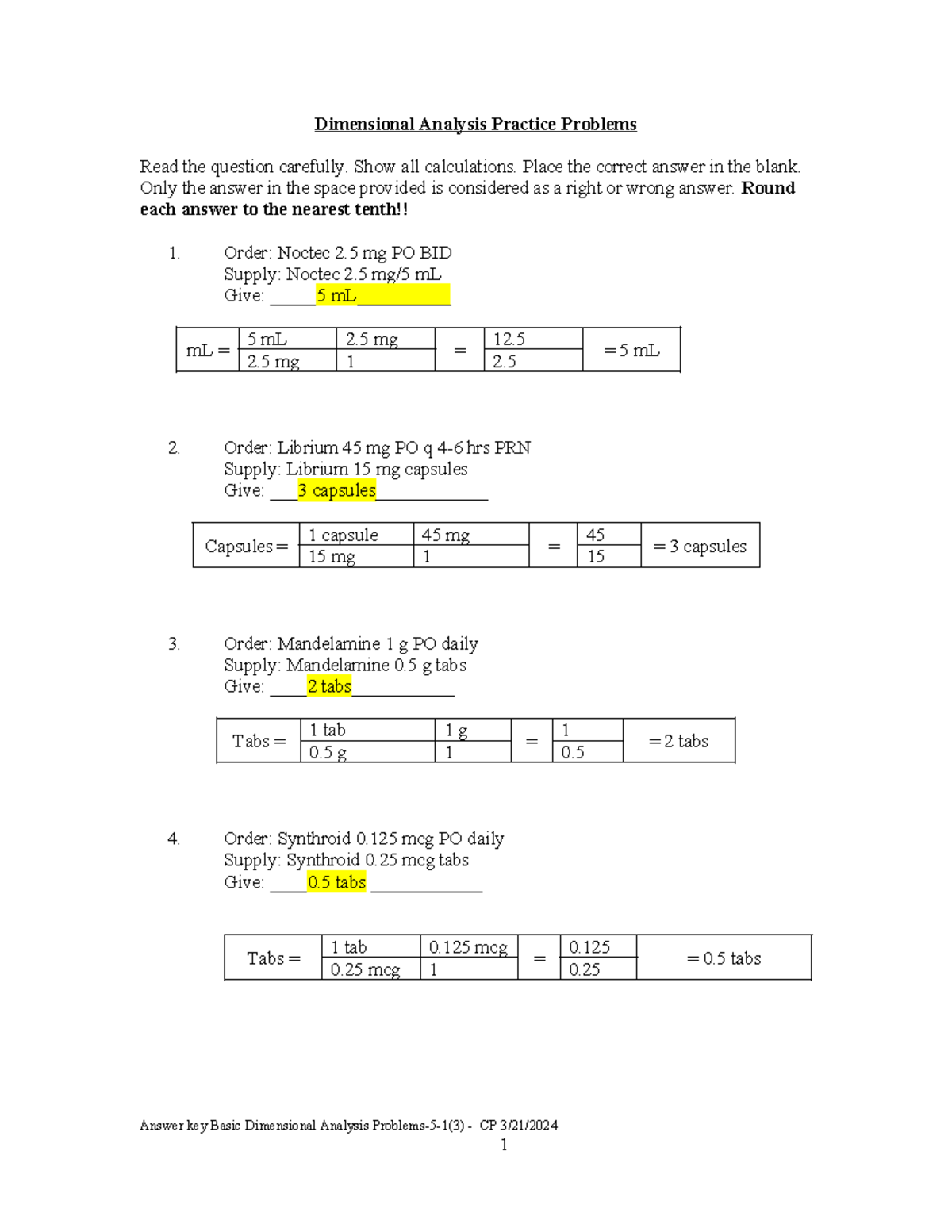

Dimensional analysis is a fundamental concept in physics and engineering that involves analyzing the relationships between different physical quantities by identifying their fundamental dimensions. This method is crucial for understanding and solving problems in various scientific and engineering disciplines. One of the best ways to master dimensional analysis is through practice. This blog post will guide you through the process of solving dimensional analysis practice problems, providing step-by-step instructions and examples to help you build a strong foundation in this essential skill.
Understanding Dimensional Analysis
Before diving into dimensional analysis practice problems, it's important to understand the basic principles of dimensional analysis. Dimensional analysis involves breaking down physical quantities into their fundamental dimensions, such as mass (M), length (L), time (T), and temperature (Θ). By expressing quantities in terms of these fundamental dimensions, you can derive relationships between different physical quantities and check the consistency of equations.
Fundamental Dimensions
The fundamental dimensions are the basic units of measurement that are used to describe physical quantities. The most common fundamental dimensions are:
- Mass (M): A measure of the amount of matter in an object.
- Length (L): A measure of the distance between two points.
- Time (T): A measure of the duration of an event.
- Temperature (Θ): A measure of the hotness or coldness of an object.
- Electric Current (I): A measure of the flow of electric charge.
- Amount of Substance (N): A measure of the number of particles in a substance.
- Luminous Intensity (J): A measure of the power emitted by a light source in a particular direction.
Dimensional Analysis Practice Problems
Now that you have a basic understanding of dimensional analysis, let's dive into some practice problems. These problems will help you apply the principles of dimensional analysis to real-world scenarios.
Problem 1: Velocity
Determine the dimensions of velocity. Velocity is defined as the rate of change of position with respect to time.
Step 1: Identify the formula for velocity.
The formula for velocity (v) is:
v = Δx / Δt
where Δx is the change in position and Δt is the change in time.
Step 2: Express the formula in terms of fundamental dimensions.
The change in position (Δx) has the dimension of length (L), and the change in time (Δt) has the dimension of time (T). Therefore, the dimensions of velocity are:
v = L / T
So, the dimensions of velocity are L/T.
💡 Note: Velocity is a vector quantity, meaning it has both magnitude and direction. However, in dimensional analysis, we focus on the magnitude and its dimensions.
Problem 2: Acceleration
Determine the dimensions of acceleration. Acceleration is defined as the rate of change of velocity with respect to time.
Step 1: Identify the formula for acceleration.
The formula for acceleration (a) is:
a = Δv / Δt
where Δv is the change in velocity and Δt is the change in time.
Step 2: Express the formula in terms of fundamental dimensions.
From Problem 1, we know that the dimensions of velocity (v) are L/T. Therefore, the change in velocity (Δv) also has the dimensions of L/T. The change in time (Δt) has the dimension of time (T). Therefore, the dimensions of acceleration are:
a = (L/T) / T = L/T²
So, the dimensions of acceleration are L/T².
Problem 3: Force
Determine the dimensions of force. Force is defined as mass times acceleration.
Step 1: Identify the formula for force.
The formula for force (F) is:
F = m * a
where m is mass and a is acceleration.
Step 2: Express the formula in terms of fundamental dimensions.
The dimension of mass (m) is M, and from Problem 2, we know that the dimensions of acceleration (a) are L/T². Therefore, the dimensions of force are:
F = M * (L/T²) = M * L/T²
So, the dimensions of force are M * L/T².
Problem 4: Energy
Determine the dimensions of energy. Energy is defined as the ability to do work, and work is defined as force times distance.
Step 1: Identify the formula for work.
The formula for work (W) is:
W = F * d
where F is force and d is distance.
Step 2: Express the formula in terms of fundamental dimensions.
From Problem 3, we know that the dimensions of force (F) are M * L/T². The dimension of distance (d) is L. Therefore, the dimensions of work (and energy) are:
W = (M * L/T²) * L = M * L²/T²
So, the dimensions of energy are M * L²/T².
Problem 5: Power
Determine the dimensions of power. Power is defined as the rate at which work is done.
Step 1: Identify the formula for power.
The formula for power (P) is:
P = W / t
where W is work and t is time.
Step 2: Express the formula in terms of fundamental dimensions.
From Problem 4, we know that the dimensions of work (W) are M * L²/T². The dimension of time (t) is T. Therefore, the dimensions of power are:
P = (M * L²/T²) / T = M * L²/T³
So, the dimensions of power are M * L²/T³.
Problem 6: Pressure
Determine the dimensions of pressure. Pressure is defined as force per unit area.
Step 1: Identify the formula for pressure.
The formula for pressure (P) is:
P = F / A
where F is force and A is area.
Step 2: Express the formula in terms of fundamental dimensions.
From Problem 3, we know that the dimensions of force (F) are M * L/T². The dimension of area (A) is L². Therefore, the dimensions of pressure are:
P = (M * L/T²) / L² = M / (L * T²)
So, the dimensions of pressure are M / (L * T²).
Problem 7: Density
Determine the dimensions of density. Density is defined as mass per unit volume.
Step 1: Identify the formula for density.
The formula for density (ρ) is:
ρ = m / V
where m is mass and V is volume.
Step 2: Express the formula in terms of fundamental dimensions.
The dimension of mass (m) is M, and the dimension of volume (V) is L³. Therefore, the dimensions of density are:
ρ = M / L³
So, the dimensions of density are M / L³.
Problem 8: Specific Heat Capacity
Determine the dimensions of specific heat capacity. Specific heat capacity is defined as the amount of heat required to raise the temperature of a unit mass of a substance by one degree.
Step 1: Identify the formula for specific heat capacity.
The formula for specific heat capacity (c) is:
c = Q / (m * ΔT)
where Q is heat, m is mass, and ΔT is the change in temperature.
Step 2: Express the formula in terms of fundamental dimensions.
The dimension of heat (Q) is M * L²/T² (from Problem 4), the dimension of mass (m) is M, and the dimension of temperature change (ΔT) is Θ. Therefore, the dimensions of specific heat capacity are:
c = (M * L²/T²) / (M * Θ) = L²/(T² * Θ)
So, the dimensions of specific heat capacity are L²/(T² * Θ).
Problem 9: Thermal Conductivity
Determine the dimensions of thermal conductivity. Thermal conductivity is defined as the ability of a material to conduct heat.
Step 1: Identify the formula for thermal conductivity.
The formula for thermal conductivity (k) is:
k = Q * L / (A * ΔT * t)
where Q is heat, L is length, A is area, ΔT is the change in temperature, and t is time.
Step 2: Express the formula in terms of fundamental dimensions.
The dimension of heat (Q) is M * L²/T² (from Problem 4), the dimension of length (L) is L, the dimension of area (A) is L², the dimension of temperature change (ΔT) is Θ, and the dimension of time (t) is T. Therefore, the dimensions of thermal conductivity are:
k = (M * L²/T²) * L / (L² * Θ * T) = M * L / (T³ * Θ)
So, the dimensions of thermal conductivity are M * L / (T³ * Θ).
Problem 10: Viscosity
Determine the dimensions of viscosity. Viscosity is defined as the resistance of a fluid to flow.
Step 1: Identify the formula for viscosity.
The formula for viscosity (η) is:
η = F * t / A
where F is force, t is time, and A is area.
Step 2: Express the formula in terms of fundamental dimensions.
From Problem 3, we know that the dimensions of force (F) are M * L/T². The dimension of time (t) is T, and the dimension of area (A) is L². Therefore, the dimensions of viscosity are:
η = (M * L/T²) * T / L² = M / (L * T)
So, the dimensions of viscosity are M / (L * T).
Dimensional Analysis in Real-World Applications
Dimensional analysis is not just a theoretical concept; it has numerous real-world applications. Here are a few examples:
- Engineering Design: Engineers use dimensional analysis to design systems and components that meet specific performance criteria. By understanding the dimensions of various physical quantities, engineers can ensure that their designs are both efficient and safe.
- Fluid Dynamics: In fluid dynamics, dimensional analysis is used to study the behavior of fluids in motion. By analyzing the dimensions of quantities such as velocity, pressure, and viscosity, scientists can derive important relationships and equations that describe fluid flow.
- Thermodynamics: In thermodynamics, dimensional analysis is used to study the relationships between heat, work, and energy. By understanding the dimensions of these quantities, scientists can derive important laws and principles that govern the behavior of thermodynamic systems.
- Astronomy: In astronomy, dimensional analysis is used to study the behavior of celestial bodies and the forces that act on them. By analyzing the dimensions of quantities such as mass, distance, and time, astronomers can derive important relationships and equations that describe the motion of planets, stars, and galaxies.
Common Mistakes in Dimensional Analysis
While dimensional analysis is a powerful tool, it is also easy to make mistakes. Here are some common pitfalls to avoid:
- Incorrect Fundamental Dimensions: Make sure you are using the correct fundamental dimensions for each physical quantity. For example, velocity has dimensions of L/T, not L²/T.
- Incorrect Formulas: Ensure that you are using the correct formulas for each physical quantity. For example, the formula for force is F = m * a, not F = m / a.
- Incorrect Units: Be consistent with your units. If you are using meters for length, make sure you are using seconds for time, not minutes or hours.
- Ignoring Vector Quantities: Remember that some physical quantities are vectors, meaning they have both magnitude and direction. While dimensional analysis focuses on magnitude, it's important to keep the vector nature of these quantities in mind.
By avoiding these common mistakes, you can ensure that your dimensional analysis is accurate and reliable.
Practice Makes Perfect
Mastering dimensional analysis requires practice. The more problems you solve, the more comfortable you will become with the concepts and techniques involved. Here are some tips to help you improve your dimensional analysis skills:
- Start with Simple Problems: Begin with simple problems that involve only a few physical quantities. As you become more comfortable with the basics, you can move on to more complex problems.
- Check Your Work: Always double-check your work to ensure that your dimensions are correct. This will help you catch any mistakes early and avoid costly errors.
- Practice Regularly: Make dimensional analysis practice a regular part of your study routine. The more you practice, the better you will become.
- Seek Help When Needed: If you are struggling with a particular problem or concept, don't hesitate to seek help from a teacher, tutor, or classmate. Sometimes, a fresh perspective can make all the difference.
By following these tips and practicing regularly, you can develop a strong foundation in dimensional analysis and apply it to a wide range of scientific and engineering problems.
Dimensional analysis is a fundamental concept in physics and engineering that involves analyzing the relationships between different physical quantities by identifying their fundamental dimensions. By understanding and practicing dimensional analysis, you can derive important relationships and equations that describe the behavior of physical systems. Whether you are studying fluid dynamics, thermodynamics, or astronomy, dimensional analysis is an essential tool that will help you succeed in your scientific and engineering endeavors.
Dimensional analysis practice problems are a great way to build your skills and gain confidence in this important area of study. By solving a variety of problems and checking your work carefully, you can ensure that your dimensional analysis is accurate and reliable. So, grab a pencil and paper, and start practicing today!
Dimensional analysis is a powerful tool that can help you understand and solve a wide range of scientific and engineering problems. By mastering the principles of dimensional analysis and practicing regularly, you can develop a strong foundation in this essential skill and apply it to a variety of real-world applications. Whether you are studying physics, engineering, or any other scientific discipline, dimensional analysis is an important tool that will help you succeed in your academic and professional endeavors.
Dimensional analysis is a fundamental concept in physics and engineering that involves analyzing the relationships between different physical quantities by identifying their fundamental dimensions. By understanding and practicing dimensional analysis, you can derive important relationships and equations that describe the behavior of physical systems. Whether you are studying fluid dynamics, thermodynamics, or astronomy, dimensional analysis is an essential tool that will help you succeed in your scientific and engineering endeavors.
Dimensional analysis practice problems are a great way to build your skills and gain confidence in this important area of study. By solving a variety of problems and checking your work carefully, you can ensure that your dimensional analysis is accurate and reliable. So, grab a pencil and paper, and start practicing today!
Dimensional analysis is a powerful tool that can help you understand and solve a wide range of scientific and engineering problems. By mastering the principles of dimensional analysis and practicing regularly, you can develop a strong foundation in this essential skill and apply it to a variety of real-world applications. Whether you are studying physics, engineering, or any other scientific discipline, dimensional analysis is an important tool that will help you succeed in your academic and professional endeavors.
Dimensional analysis is a fundamental concept in physics and engineering that involves analyzing the relationships between different physical quantities by identifying their fundamental dimensions. By understanding and practicing dimensional analysis, you can derive important relationships and equations that describe the behavior of physical systems. Whether you are studying fluid dynamics, thermodynamics, or astronomy, dimensional analysis is an essential tool that will help you succeed in your scientific and engineering endeavors.
Dimensional analysis practice problems are a great way to build your skills and gain confidence in this important area of study. By solving a variety of problems and checking your work carefully, you can ensure that your dimensional analysis is accurate and reliable. So, grab a pencil and paper, and start practicing today!
Dimensional analysis is a powerful tool that can help you understand and solve a wide range of scientific and engineering problems. By mastering the principles of dimensional analysis and practicing regularly, you can develop a strong foundation in this essential skill and apply it to a variety of real-world applications. Whether you are studying physics, engineering, or any other scientific discipline, dimensional analysis is an important tool that will help you succeed in your academic and professional endeavors.
Dimensional analysis is a fundamental concept in physics and engineering that involves analyzing the relationships between different physical quantities by identifying their fundamental dimensions. By understanding and practicing dimensional analysis, you can derive important relationships and equations that describe the behavior of physical systems. Whether you are studying fluid dynamics, thermodynamics, or astronomy, dimensional analysis is an essential tool that will help you succeed in your scientific and engineering endeavors.
Dimensional analysis practice problems are a great way to build your skills and gain confidence in this important area of study. By solving a variety of problems and checking your work carefully, you can ensure that your dimensional analysis is accurate and reliable. So, grab a pencil and paper, and start practicing today!
Dimensional analysis is a powerful tool that can help you understand and solve a wide range of scientific and engineering problems. By mastering the principles of dimensional analysis and practicing regularly