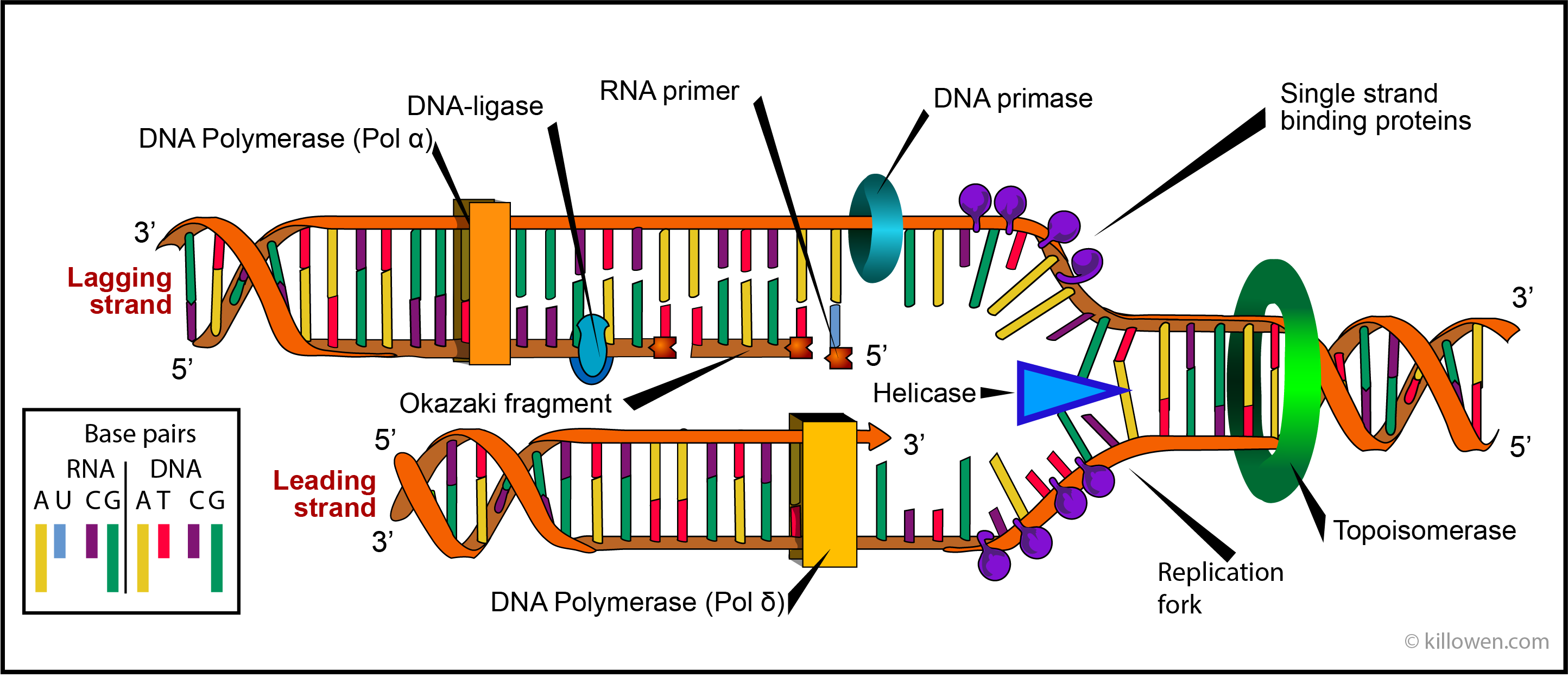

Understanding the intricacies of DNA replication is fundamental to grasping the mechanisms of life itself. The DNA Replication Model provides a comprehensive framework for how genetic information is copied and passed on from one generation to the next. This process is not only crucial for the survival and propagation of organisms but also serves as a cornerstone for various fields in biology, including genetics, molecular biology, and biotechnology.
Understanding the Basics of DNA Replication
DNA replication is the process by which a single DNA molecule is copied to produce two identical molecules. This process is semi-conservative, meaning each new DNA molecule contains one strand from the original DNA and one newly synthesized strand. The DNA Replication Model outlines several key steps and components involved in this process:
- Initiation: The process begins at specific sites on the DNA called origins of replication. Here, the DNA helix unwinds, and enzymes called helicases separate the two strands.
- Elongation: DNA polymerase enzymes then read the template strands and synthesize new complementary strands. This occurs in the 5' to 3' direction.
- Termination: The process ends when the entire DNA molecule has been replicated, and the new strands are ligated together.
The Key Players in DNA Replication
The DNA Replication Model involves a variety of enzymes and proteins that work together to ensure accurate replication. Some of the key players include:
- Helicase: This enzyme unwinds the DNA double helix by breaking the hydrogen bonds between the base pairs.
- Single-Strand Binding Proteins (SSBPs): These proteins stabilize the single-stranded DNA to prevent it from re-annealing.
- Primase: This enzyme synthesizes short RNA primers that are necessary for DNA polymerase to start replication.
- DNA Polymerase: This enzyme adds nucleotides to the growing DNA strand in the 5' to 3' direction.
- Ligase: This enzyme joins the Okazaki fragments together to form a continuous strand.
The Mechanism of DNA Replication
The DNA Replication Model can be broken down into several detailed steps:
Initiation
The initiation of DNA replication begins at specific sites called origins of replication. These sites are recognized by initiator proteins, which recruit other proteins to form a pre-replication complex. The helicase then unwinds the DNA, creating a replication fork. Single-strand binding proteins stabilize the unwound DNA, preventing it from re-annealing.
Elongation
During elongation, DNA polymerase reads the template strand in the 3' to 5' direction and synthesizes a new complementary strand in the 5' to 3' direction. This process occurs continuously on the leading strand and discontinuously on the lagging strand, where short fragments called Okazaki fragments are synthesized.
On the leading strand, DNA polymerase can continuously add nucleotides to the growing strand. However, on the lagging strand, DNA polymerase synthesizes short Okazaki fragments, which are then joined together by DNA ligase.
Termination
The termination of DNA replication occurs when the entire DNA molecule has been replicated. The newly synthesized strands are ligated together by DNA ligase, forming a continuous double-stranded DNA molecule. The replication forks converge, and the process is completed.
The Role of DNA Replication in Cell Division
DNA replication is a critical process in cell division, ensuring that each daughter cell receives an identical copy of the genetic material. During mitosis, the replicated DNA is condensed into chromosomes, which are then separated into the daughter cells. This process is essential for the growth and development of multicellular organisms.
In prokaryotic cells, DNA replication occurs continuously throughout the cell cycle, allowing for rapid cell division. In eukaryotic cells, DNA replication is tightly regulated and occurs during the S phase of the cell cycle.
Errors and Repair Mechanisms in DNA Replication
Despite the high fidelity of DNA replication, errors can occur. These errors, if not corrected, can lead to mutations and potentially harmful genetic changes. The DNA Replication Model includes several repair mechanisms to ensure the accuracy of the replicated DNA:
- Proofreading: DNA polymerase has a proofreading function that checks for errors and corrects them by removing incorrect nucleotides.
- Mismatch Repair: This mechanism identifies and corrects mismatched base pairs that occur during replication.
- Nucleotide Excision Repair: This process removes and replaces damaged nucleotides, ensuring the integrity of the DNA.
These repair mechanisms are crucial for maintaining the stability and accuracy of the genetic information passed on to future generations.
🔍 Note: Errors in DNA replication can lead to mutations, which can have significant implications for genetic disorders and cancer development.
Applications of the DNA Replication Model
The DNA Replication Model has wide-ranging applications in various fields of biology and biotechnology. Understanding the mechanisms of DNA replication is essential for:
- Genetic Engineering: Manipulating DNA to introduce or modify genes in organisms.
- Biotechnology: Developing techniques for cloning, gene therapy, and genetic testing.
- Cancer Research: Studying the role of DNA replication errors in cancer development and treatment.
- Forensic Science: Using DNA analysis for identification and criminal investigations.
Challenges and Future Directions
While the DNA Replication Model provides a comprehensive understanding of the replication process, there are still challenges and areas for further research. Some of the key challenges include:
- Understanding Replication in Complex Genomes: The replication of complex genomes, such as those in eukaryotes, involves additional regulatory mechanisms that are not fully understood.
- Error Correction Mechanisms: Further research is needed to fully understand the various error correction mechanisms and their roles in maintaining genetic stability.
- Technological Advances: Developing new technologies for studying DNA replication at a molecular level can provide deeper insights into the process.
Future research in these areas will continue to enhance our understanding of DNA replication and its implications for health and disease.
In conclusion, the DNA Replication Model is a fundamental concept in molecular biology that explains how genetic information is copied and passed on. This process involves a complex interplay of enzymes and proteins, ensuring the accurate replication of DNA. Understanding the mechanisms of DNA replication is crucial for various fields, including genetics, biotechnology, and cancer research. As research continues, we can expect to gain deeper insights into the intricacies of DNA replication and its role in life processes.
Related Terms:
- different models of dna replication
- dna replication model worksheet
- conservative dna replication
- dna replication diagram
- dna replication model with labels
- how does dna replication happen