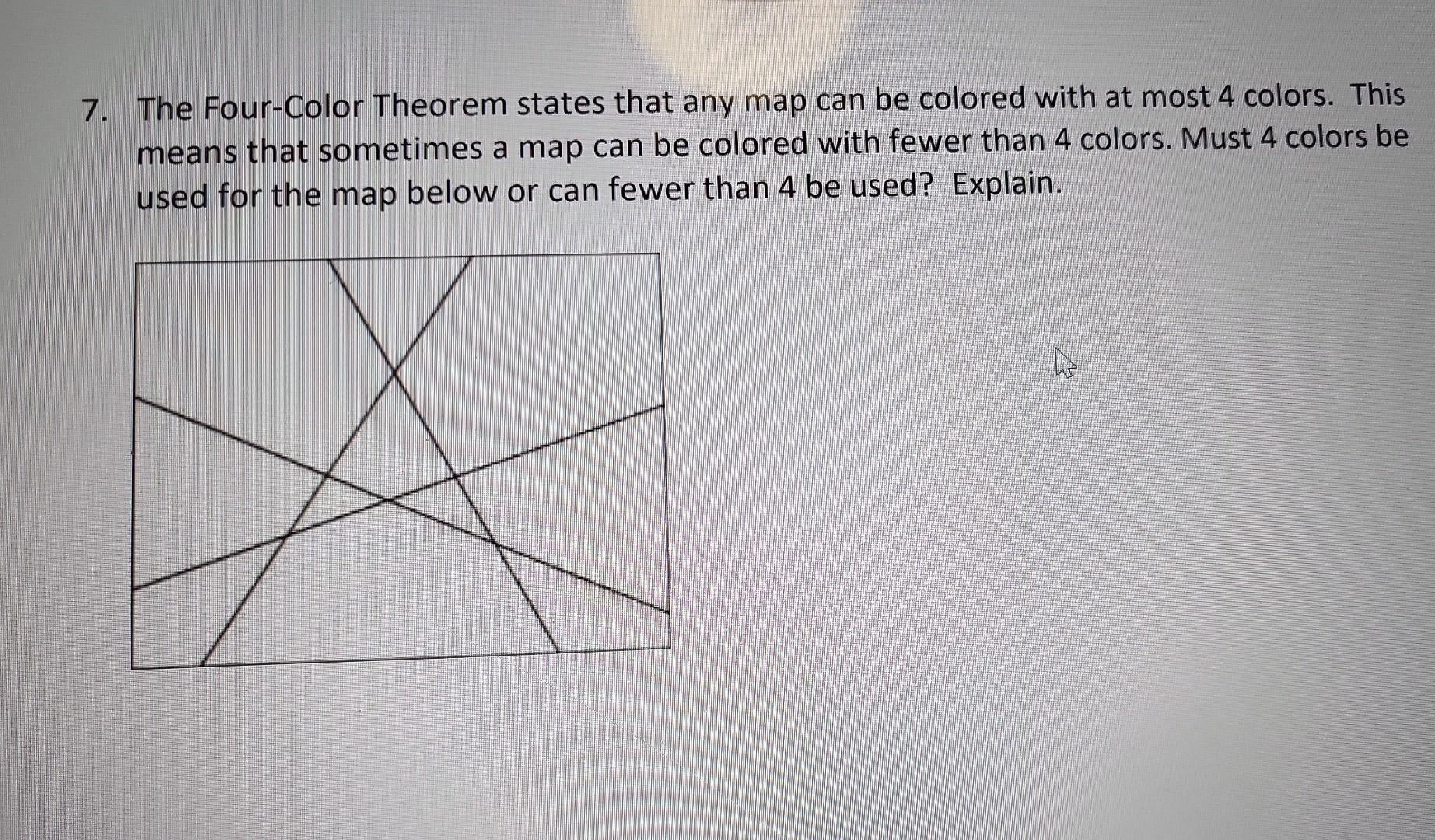

The Four Color Map theorem is one of the most fascinating and well-known results in the field of graph theory and topology. It states that any map in a plane can be colored using no more than four colors in such a way that no two adjacent regions share the same color. This theorem has captivated mathematicians and enthusiasts alike for over a century, and its proof has a rich history involving some of the brightest minds in mathematics.
The History of the Four Color Map Theorem
The Four Color Map problem was first proposed in 1852 by Francis Guthrie, a young English mathematician. He observed that any map could be colored with just four colors so that no two adjacent regions shared the same color. This observation led to a long-standing conjecture that became known as the Four Color Conjecture. The problem intrigued many mathematicians, including Augustus De Morgan, who passed it on to other prominent mathematicians of the time.
Over the years, numerous attempts were made to prove the conjecture, but it remained elusive. The problem was so challenging that it became one of the most famous unsolved problems in mathematics. It was not until the late 20th century that the conjecture was finally proven true.
The Proof of the Four Color Map Theorem
The breakthrough came in 1976 when Kenneth Appel and Wolfgang Haken, two mathematicians from the University of Illinois, announced that they had proven the Four Color Map theorem using a computer-assisted proof. Their proof involved checking a vast number of configurations, which was beyond the capability of human mathematicians to verify manually. The proof relied on reducing the problem to a finite number of cases and then using a computer to check each case.
The proof was controversial at first because it relied heavily on computer verification. However, over time, the mathematical community accepted the proof as valid. The use of computers in mathematical proofs has since become more common, and the Four Color Map theorem stands as a landmark example of how computers can assist in solving complex mathematical problems.
Applications of the Four Color Map Theorem
The Four Color Map theorem has applications beyond just coloring maps. It has implications in various fields, including computer science, electrical engineering, and even biology. Here are a few notable applications:
- Graph Theory: The theorem is fundamental in graph theory, where it is used to study the coloring of graphs. Graph coloring has applications in scheduling, network design, and resource allocation.
- Electrical Engineering: In circuit design, the Four Color Map theorem can be used to ensure that no two adjacent wires carry the same signal, which is crucial for preventing short circuits.
- Biology: In molecular biology, the theorem can be applied to study the structure of proteins and DNA, where different regions need to be distinguished based on their properties.
The Impact on Mathematics
The proof of the Four Color Map theorem had a profound impact on the field of mathematics. It demonstrated the power of computational methods in solving complex problems that were previously thought to be intractable. The theorem also highlighted the importance of collaboration and the use of technology in mathematical research.
Moreover, the Four Color Map theorem inspired further research in graph theory and topology. Mathematicians have since explored other coloring problems and related conjectures, leading to new discoveries and insights. The theorem serves as a reminder of the beauty and complexity of mathematics, and it continues to inspire new generations of mathematicians.
Challenges and Controversies
Despite its acceptance, the Four Color Map theorem has not been without controversy. The reliance on computer verification has raised questions about the nature of mathematical proofs. Some mathematicians argue that a proof should be verifiable by humans alone, while others see the use of computers as a natural extension of mathematical tools.
Another challenge is the sheer complexity of the proof. The original proof by Appel and Haken involved checking over 1,900 configurations, a task that would be impossible for a human to verify manually. This complexity has led to efforts to simplify the proof and make it more accessible. Over the years, several simplified proofs have been proposed, but none have yet matched the elegance and simplicity of the original proof.
Future Directions
The Four Color Map theorem continues to be a subject of interest for mathematicians and computer scientists. Future research may focus on finding more elegant and human-verifiable proofs, as well as exploring related problems in graph theory and topology. The use of advanced computational techniques and artificial intelligence may also play a role in furthering our understanding of the theorem and its applications.
Additionally, the Four Color Map theorem has inspired related conjectures and problems, such as the Five Color Theorem and the Hexagonal Tiling Problem. These problems offer new challenges and opportunities for mathematical exploration.
💡 Note: The Four Color Map theorem is a cornerstone of graph theory and has wide-ranging applications in various fields. Its proof, while controversial at first, has been accepted as a valid example of how computers can assist in solving complex mathematical problems.
In conclusion, the Four Color Map theorem is a testament to the power of mathematical reasoning and the use of technology in solving complex problems. Its proof has had a lasting impact on the field of mathematics and continues to inspire new research and discoveries. The theorem’s applications in various fields highlight its relevance and importance in modern science and technology. As we continue to explore the depths of mathematics, the Four Color Map theorem will remain a shining example of human ingenuity and the beauty of mathematical thought.
Related Terms:
- four color map theorem proof
- 4 color map theory
- proof of 4 color theorem
- 4 color map theorem proof
- four color theorem math problem
- four color map theory