
The Hyperbolic Tangent Function, often abbreviated as tanh, is a fundamental concept in mathematics and has wide-ranging applications in various fields, including physics, engineering, and machine learning. This function is particularly useful in modeling systems that exhibit exponential growth or decay, making it a crucial tool for scientists and engineers alike. In this blog post, we will delve into the intricacies of the Hyperbolic Tangent Function, exploring its definition, properties, and practical applications.
Understanding the Hyperbolic Tangent Function
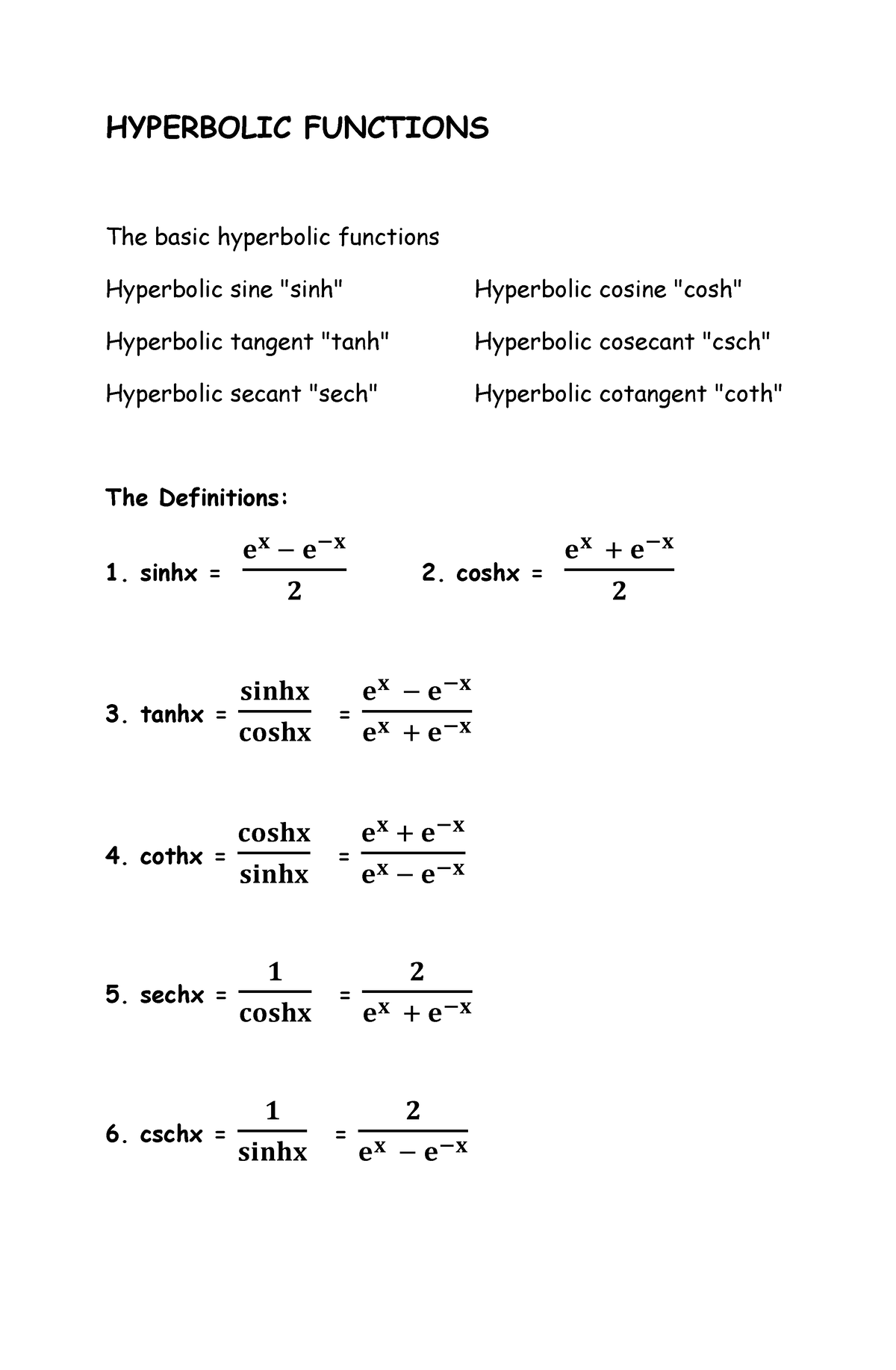
The Hyperbolic Tangent Function is defined as the ratio of the hyperbolic sine function to the hyperbolic cosine function. Mathematically, it is expressed as:
tanh(x) = sinh(x) / cosh(x)
Where:
- sinh(x) is the hyperbolic sine function, defined as (e^x - e^(-x)) / 2.
- cosh(x) is the hyperbolic cosine function, defined as (e^x + e^(-x)) / 2.
This function is particularly useful because it maps all real numbers to the interval (-1, 1), making it ideal for applications that require bounded outputs.
Properties of the Hyperbolic Tangent Function
The Hyperbolic Tangent Function has several important properties that make it a valuable tool in various mathematical and scientific contexts. Some of these properties include:
- Odd Function: The Hyperbolic Tangent Function is an odd function, meaning tanh(-x) = -tanh(x).
- Derivative: The derivative of the Hyperbolic Tangent Function is given by tanh'(x) = 1 - tanh^2(x).
- Range: The range of the Hyperbolic Tangent Function is (-1, 1), which means it never reaches the values -1 or 1.
- Asymptotes: The function has horizontal asymptotes at y = 1 and y = -1 as x approaches positive and negative infinity, respectively.
These properties make the Hyperbolic Tangent Function a versatile tool in various mathematical and scientific applications.
Applications of the Hyperbolic Tangent Function
The Hyperbolic Tangent Function finds applications in a wide range of fields, from physics and engineering to machine learning and data science. Some of the key applications include:
Physics and Engineering
In physics, the Hyperbolic Tangent Function is used to model systems that exhibit exponential growth or decay. For example, it is used in the study of hyperbolic geometry, where it helps in understanding the properties of hyperbolic spaces. In engineering, it is used in signal processing and control systems to model nonlinear behaviors.
Machine Learning
In machine learning, the Hyperbolic Tangent Function is commonly used as an activation function in neural networks. It is particularly useful in hidden layers of neural networks because it can model nonlinear relationships and help the network learn complex patterns. The Hyperbolic Tangent Function is often preferred over the sigmoid function because it can handle a wider range of inputs and outputs, leading to better performance in many applications.
Here is a comparison of the Hyperbolic Tangent Function and the Sigmoid Function:
| Property | Hyperbolic Tangent Function | Sigmoid Function |
|---|---|---|
| Range | (-1, 1) | (0, 1) |
| Derivative | 1 - tanh^2(x) | σ(x) * (1 - σ(x)) |
| Asymptotes | y = 1 and y = -1 | y = 1 and y = 0 |
As shown in the table, the Hyperbolic Tangent Function has a wider range and different asymptotes compared to the Sigmoid Function, making it a more versatile choice for many applications.
💡 Note: The choice between the Hyperbolic Tangent Function and the Sigmoid Function depends on the specific requirements of the neural network and the problem at hand. Both functions have their strengths and weaknesses, and the best choice often depends on the context.
Data Science
In data science, the Hyperbolic Tangent Function is used in various statistical models and algorithms. For example, it is used in logistic regression to model the probability of binary outcomes. It is also used in time series analysis to model trends and seasonality in data.
Implementation in Programming Languages
The Hyperbolic Tangent Function can be easily implemented in various programming languages. Below are examples of how to implement the Hyperbolic Tangent Function in Python and MATLAB.
Python
In Python, the Hyperbolic Tangent Function can be implemented using the math library or the numpy library. Here is an example using the math library:
import math

def hyperbolic_tangent(x):
    return math.sinh(x) / math.cosh(x)

# Example usage
x = 1.0
result = hyperbolic_tangent(x)
print(f"tanh({x}) = {result}")
Alternatively, you can use the numpy library for more efficient computations:
import numpy as np

def hyperbolic_tangent(x):
    return np.tanh(x)

# Example usage
x = 1.0
result = hyperbolic_tangent(x)
print(f"tanh({x}) = {result}")
MATLAB
In MATLAB, the Hyperbolic Tangent Function can be implemented using the built-in tanh function. Here is an example:
function result = hyperbolic_tangent(x)
    result = tanh(x);
end

% Example usage
x = 1.0;
result = hyperbolic_tangent(x);
disp(['tanh(', num2str(x), ') = ', num2str(result)]);
These implementations demonstrate how the Hyperbolic Tangent Function can be easily integrated into various programming environments, making it a versatile tool for developers and researchers.
In conclusion, the Hyperbolic Tangent Function is a powerful mathematical tool with wide-ranging applications in physics, engineering, machine learning, and data science. Its unique properties, such as its odd nature and bounded range, make it an essential function for modeling complex systems and solving real-world problems. Whether you are a mathematician, engineer, or data scientist, understanding and utilizing the Hyperbolic Tangent Function can significantly enhance your analytical and computational capabilities.
Related Terms:
- tanh function
- hyperbolic tangent function formula
- hyperbolic tangent function calculator
- inverse hyperbolic tangent function
- hyperbolic tangent formula
- hyperbolic tangent function graph