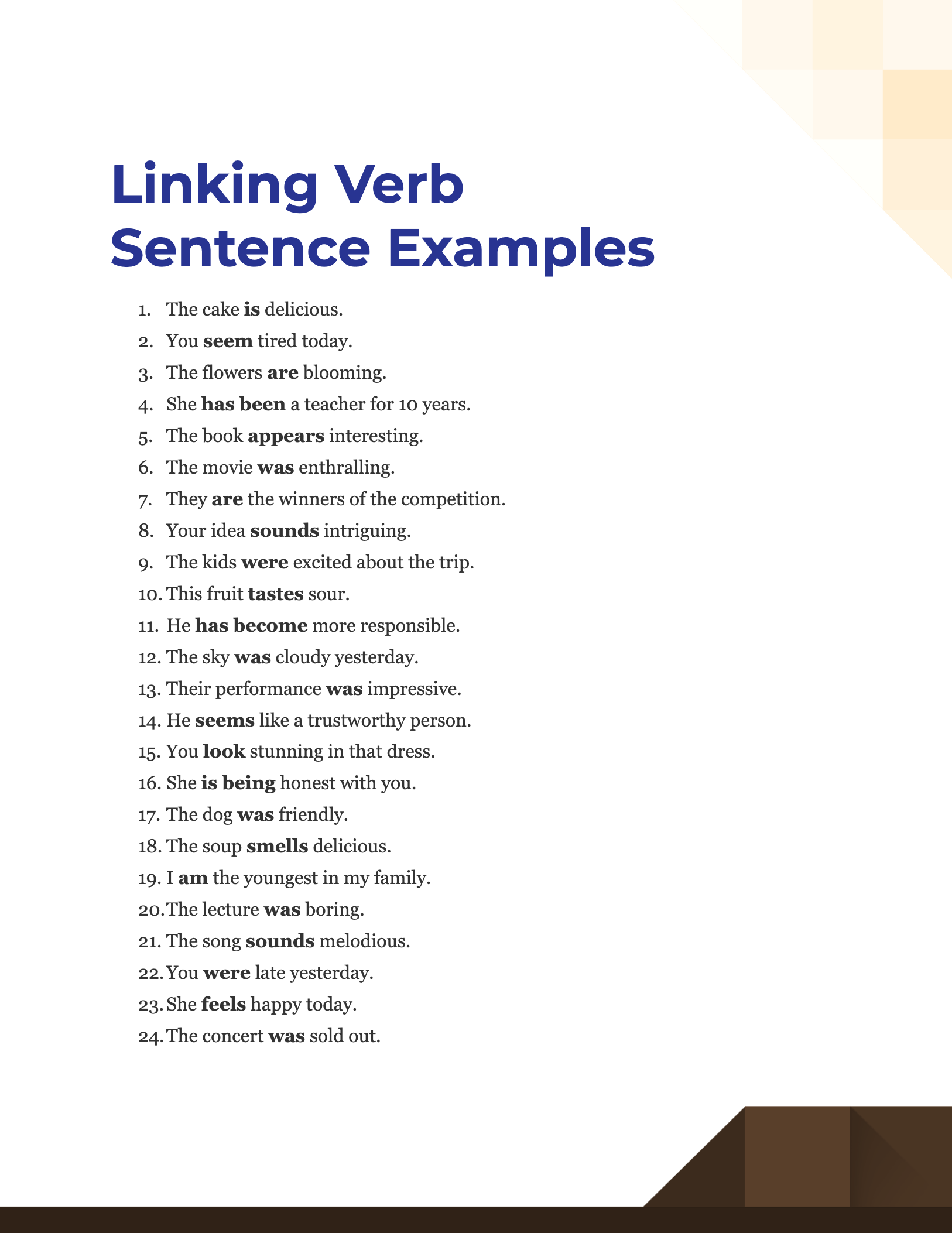

Understanding the intricacies of grammar can significantly enhance your writing skills. One of the fundamental aspects of grammar is the use of linking verbs. A linking verb list is essential for any writer aiming to convey ideas clearly and effectively. Linking verbs connect the subject of a sentence to additional information about that subject, such as its state, condition, or identity. This blog post will delve into the importance of linking verbs, provide a comprehensive linking verb list, and offer practical examples to illustrate their usage.
What Are Linking Verbs?
Linking verbs are a type of verb that connects the subject of a sentence to a subject complement, which can be a noun, pronoun, or adjective. Unlike action verbs, which show what the subject is doing, linking verbs describe the state or condition of the subject. Common linking verbs include forms of the verb “to be,” such as “am,” “is,” “are,” “was,” and “were,” as well as verbs like “seem,” “become,” “appear,” and “feel.”
The Importance of Linking Verbs
Linking verbs play a crucial role in sentence structure and meaning. They help to:
- Describe the state or condition of the subject.
- Provide additional information about the subject.
- Create clear and concise sentences.
- Enhance the overall flow and readability of the text.
Common Linking Verbs
Here is a comprehensive linking verb list that includes the most commonly used linking verbs:
| Linking Verb | Example |
|---|---|
| am | I am happy. |
| is | The sky is blue. |
| are | They are friends. |
| was | She was tired. |
| were | We were excited. |
| become | He became a doctor. |
| seem | It seems like rain. |
| appear | The problem appears to be solved. |
| feel | She feels better today. |
| look | You look great! |
| sound | That sounds interesting. |
| smell | The flowers smell wonderful. |
| taste | The cake tastes delicious. |
📝 Note: This linking verb list is not exhaustive, but it covers the most commonly used linking verbs in English.
Examples of Linking Verbs in Sentences
To better understand how linking verbs function, let’s look at some examples:
- She is a teacher. (Here, “is” links the subject “She” to the subject complement “a teacher.”)
- The soup tastes salty. (In this sentence, “tastes” links the subject “The soup” to the subject complement “salty.”)
- They seem happy. (Here, “seem” links the subject “They” to the subject complement “happy.”)
- He became a lawyer. (In this example, “became” links the subject “He” to the subject complement “a lawyer.”)
- The book appears interesting. (Here, “appears” links the subject “The book” to the subject complement “interesting.”)
Linking Verbs vs. Action Verbs
It’s essential to distinguish between linking verbs and action verbs. While linking verbs describe the state or condition of the subject, action verbs show what the subject is doing. For example:
- She is happy. (Linking verb: “is” describes the state of the subject “She.”)
- She runs quickly. (Action verb: “runs” shows what the subject “She” is doing.)
Understanding the difference between these two types of verbs can help you choose the right verb for your sentence, ensuring clarity and precision in your writing.
Practical Tips for Using Linking Verbs
Here are some practical tips to help you effectively use linking verbs in your writing:
- Identify the subject of your sentence and determine what information you want to convey about it.
- Choose an appropriate linking verb from the linking verb list to connect the subject to the additional information.
- Ensure that the subject complement (noun, pronoun, or adjective) accurately describes the subject.
- Read your sentence aloud to check for clarity and flow.
- Practice using linking verbs in various contexts to improve your writing skills.
By following these tips, you can enhance your ability to use linking verbs effectively, making your writing more engaging and informative.
Linking verbs are a fundamental aspect of grammar that every writer should master. By understanding the linking verb list and how to use these verbs in sentences, you can improve the clarity and precision of your writing. Whether you are describing the state or condition of a subject or providing additional information, linking verbs play a crucial role in conveying your ideas effectively.
Incorporating linking verbs into your writing can help you create well-structured sentences that flow smoothly and are easy to understand. By practicing with various linking verbs and experimenting with different sentence structures, you can develop a strong command of this essential grammatical concept. With a solid understanding of linking verbs, you can elevate your writing skills and communicate your ideas with confidence and clarity.
Related Terms:
- all 20 linking verbs
- is was a linking verb
- most common linking verbs
- linking verb examples
- list of 20 linking verbs
- linking verb meaning