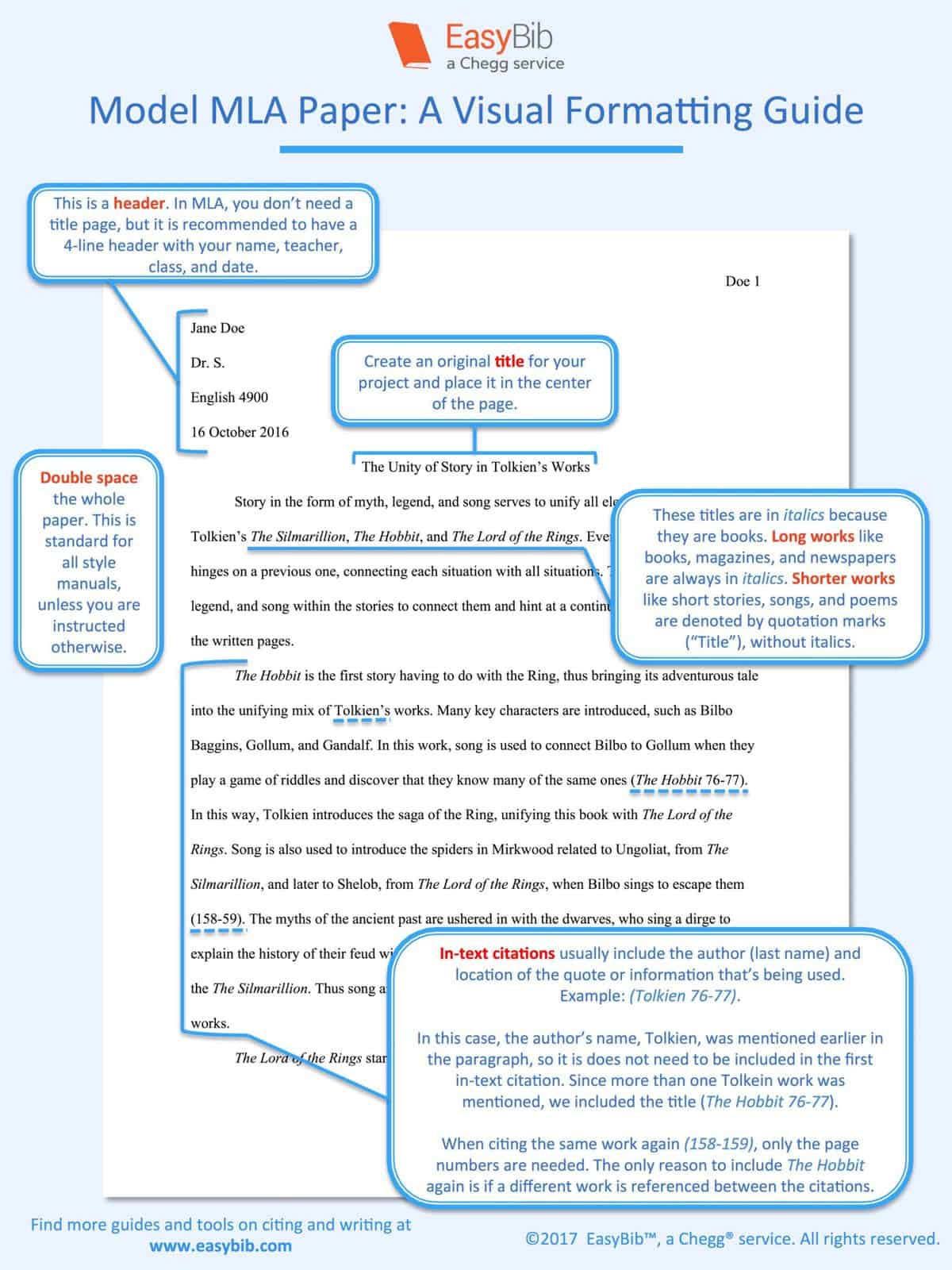

Writing an academic paper in MLA style can be a daunting task, especially for students who are new to the format. Understanding the intricacies of MLA style is crucial for presenting your research clearly and professionally. This guide will walk you through the essentials of creating an MLA style paper example, from formatting your document to citing sources correctly.
Understanding MLA Style
MLA (Modern Language Association) style is widely used in the humanities, particularly in fields such as literature, language studies, and cultural studies. It provides a consistent method for documenting sources and formatting papers. The key components of MLA style include:
- In-text citations
- Works Cited page
- Document formatting
Formatting Your MLA Style Paper
Proper formatting is the foundation of an MLA style paper. Here are the steps to format your document correctly:
General Guidelines
Your paper should be typed on standard-sized paper (8.5 x 11 inches) with 1-inch margins on all sides. Use a legible font, such as Times New Roman, in 12-point size. Double-space the entire paper, including the Works Cited page. Indent the first line of each paragraph half an inch from the left margin.
Header and Title
Include a header in the upper left corner of the first page. This header should contain your name, your instructor's name, the course number, and the date, each on a separate line. Double-space between each line. Center your title about one-third of the way down the page. Do not underline, italicize, or place your title in quotation marks. Use title case for the title.
Example:
| John Doe | Dr. Jane Smith |
| English 101 | 10 October 2023 |
Your title should be centered and formatted in title case. For example:
An Analysis of Shakespeare's Use of Imagery in "Hamlet"
Page Numbers
Include a header with your last name and the page number in the upper right corner of every page. The page number should be flush with the right margin. Do not include "p." or "pg." before the page number.
📝 Note: The header should be half an inch from the top of the page and should be right-aligned.
In-Text Citations
In-text citations are brief references within the text that direct the reader to the full citation in the Works Cited page. They are essential for giving credit to the sources you use and for allowing readers to locate those sources. Here are the basic rules for in-text citations:
Paraphrasing
When paraphrasing information from a source, include the author's last name and the page number (if available) in parentheses. For example:
According to Smith, the use of imagery in "Hamlet" enhances the play's themes (Smith 45).
Direct Quotations
When quoting directly from a source, include the author's last name, the page number, and the quotation marks. For example:
Smith argues that "the use of imagery in 'Hamlet' is crucial for understanding the play's deeper meanings" (Smith 45).
Multiple Authors
For sources with two authors, include both last names in the citation. For example:
Smith and Johnson discuss the impact of imagery on the play's themes (Smith and Johnson 45).
For sources with three or more authors, include the first author's last name followed by "et al." For example:
Smith et al. explore the various uses of imagery in "Hamlet" (Smith et al. 45).
Works Cited Page
The Works Cited page is a list of all the sources you cited in your paper. It should be on a separate page at the end of your paper, titled "Works Cited" and centered. Double-space the entire page, and use a hanging indent for each entry. Here are some examples of common citation formats:
Book
Smith, Jane. Understanding Shakespeare. New York: Publisher, 2020.
Journal Article
Johnson, Robert. "The Role of Imagery in 'Hamlet'." Shakespeare Studies, vol. 15, no. 2, 2019, pp. 34-45.
Website
Brown, Lisa. "Shakespeare's Use of Imagery." Literary Analysis, 5 Mar. 2021, https://www.literaryanalysis.com/shakespeare-imagery. Accessed 10 Oct. 2023.
Creating an MLA Style Paper Example
Let's walk through an example of an MLA style paper. This example will include a header, title, in-text citations, and a Works Cited page.
Header and Title
John Doe
Dr. Jane Smith
English 101
10 October 2023
An Analysis of Shakespeare's Use of Imagery in "Hamlet"
Body
Shakespeare's use of imagery in "Hamlet" is a critical aspect of the play's thematic development. Imagery helps to create a vivid and immersive experience for the audience, allowing them to connect more deeply with the characters and their emotions. For instance, the use of light and dark imagery throughout the play symbolizes the contrast between good and evil, knowledge and ignorance.
Smith argues that "the use of imagery in 'Hamlet' is crucial for understanding the play's deeper meanings" (Smith 45). This is evident in the character of Hamlet himself, who often uses imagery to express his inner turmoil and confusion. For example, when Hamlet says, "To be, or not to be, that is the question," he is using imagery to explore the themes of life and death (Shakespeare 3.1.56).
Johnson and Brown also discuss the impact of imagery on the play's themes. They note that the use of natural imagery, such as storms and storms, reflects the chaotic and unpredictable nature of the world in which the characters live (Johnson and Brown 67). This imagery serves to heighten the tension and drama of the play, making it more engaging for the audience.
Works Cited
Brown, Lisa. "Shakespeare's Use of Imagery." Literary Analysis, 5 Mar. 2021, https://www.literaryanalysis.com/shakespeare-imagery. Accessed 10 Oct. 2023.
Johnson, Robert. "The Role of Imagery in 'Hamlet'." Shakespeare Studies, vol. 15, no. 2, 2019, pp. 34-45.
Shakespeare, William. Hamlet. Edited by Barbara A. Mowat and Paul Werstine, Simon & Schuster Paperbacks, 2005.
Smith, Jane. Understanding Shakespeare. New York: Publisher, 2020.
This MLA style paper example demonstrates the key components of MLA formatting, including the header, title, in-text citations, and Works Cited page. By following these guidelines, you can ensure that your academic papers are well-organized, professionally presented, and properly cited.
In conclusion, mastering MLA style is essential for academic writing in the humanities. By understanding the formatting requirements, in-text citations, and Works Cited page, you can create a polished and professional MLA style paper example. Whether you are writing a research paper, essay, or any other academic document, adhering to MLA style will help you present your ideas clearly and give proper credit to your sources.
Related Terms:
- mla writing format example
- example of mla format paper
- mla student paper example
- perfect mla format example
- mla essay format example
- sample of mla format essay