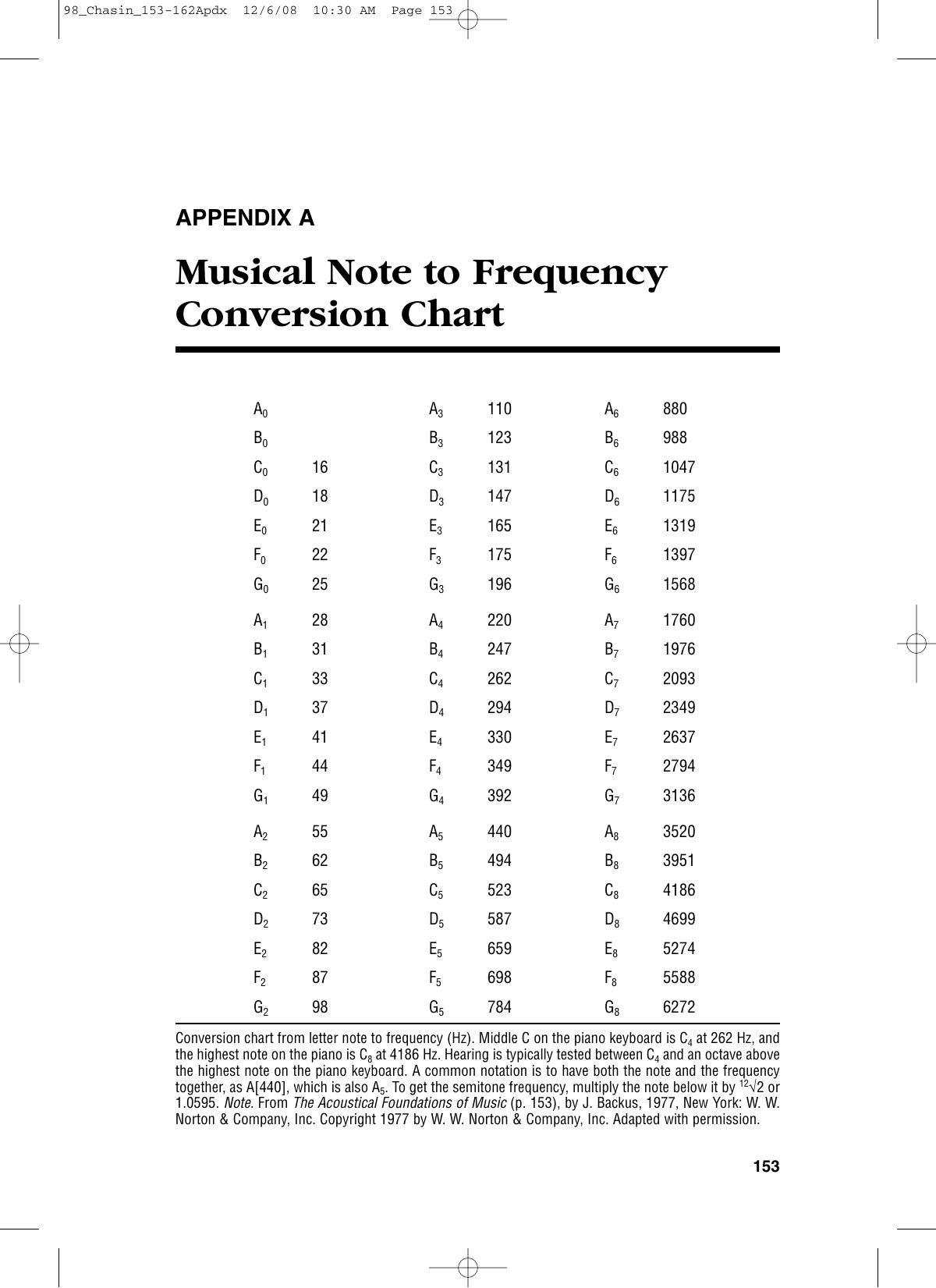

Understanding the intricacies of sound and music is a fascinating journey that often involves delving into the technical aspects of audio analysis. One of the most fundamental tools in this realm is the Note Frequency Chart. This chart is essential for musicians, sound engineers, and anyone interested in the science of sound. It provides a visual representation of the frequencies associated with different musical notes, making it easier to comprehend the relationship between pitch and frequency.
What is a Note Frequency Chart?
A Note Frequency Chart is a graphical representation that maps musical notes to their corresponding frequencies. This chart is crucial for various applications, including tuning instruments, analyzing audio recordings, and understanding the fundamentals of music theory. The chart typically covers the standard range of musical notes, from the lowest to the highest pitches that can be produced by most instruments.
Understanding Frequency and Pitch
Before diving into the Note Frequency Chart, it’s important to understand the concepts of frequency and pitch. Frequency refers to the number of vibrations per second, measured in Hertz (Hz). Pitch, on the other hand, is the perceived highness or lowness of a sound. While frequency is a physical property, pitch is a psychological perception.
For example, the note A4 (the A above middle C) has a frequency of 440 Hz. This means that the string or air column producing this note vibrates 440 times per second. The relationship between frequency and pitch is logarithmic, meaning that doubling the frequency results in an octave higher pitch.
The Standard Note Frequency Chart
The standard Note Frequency Chart is based on the equal temperament tuning system, which is the most commonly used tuning system in Western music. In this system, each octave is divided into 12 equal semitones. The frequencies of the notes are calculated using the formula:
f = f0 * 2^(n/12)
where f is the frequency of the note, f0 is the frequency of the reference note (usually A4 at 440 Hz), and n is the number of semitones above or below the reference note.
Here is a table representing the frequencies of the notes in the C major scale:
| Note | Frequency (Hz) |
|---|---|
| C4 | 261.63 |
| D4 | 293.66 |
| E4 | 329.63 |
| F4 | 349.23 |
| G4 | 392.00 |
| A4 | 440.00 |
| B4 | 493.88 |
| C5 | 523.25 |
This table provides a quick reference for the frequencies of the notes in the C major scale. However, a complete Note Frequency Chart would include all 12 notes in each octave, from C0 to C8 and beyond.
💡 Note: The frequencies listed in the table are approximate and may vary slightly depending on the tuning system used.
Applications of the Note Frequency Chart
The Note Frequency Chart has numerous applications in the fields of music and audio engineering. Some of the most common uses include:
- Instrument Tuning: Musicians use the chart to tune their instruments accurately. By knowing the exact frequency of each note, they can adjust the pitch of their instruments to match the standard frequencies.
- Audio Analysis: Sound engineers and audio analysts use the chart to analyze audio recordings. By comparing the frequencies in a recording to the standard frequencies, they can identify pitch inaccuracies and other issues.
- Music Theory: The chart is a valuable tool for music theory students. It helps them understand the relationship between different notes and intervals, as well as the structure of scales and chords.
- Synthesizer Programming: Synthesizer programmers use the chart to create accurate and realistic sounds. By programming the frequencies of each note, they can ensure that the synthesized sounds match the standard frequencies.
Creating a Note Frequency Chart
Creating a Note Frequency Chart involves calculating the frequencies of each note in the desired range. Here is a step-by-step guide to creating a basic chart:
- Choose a Reference Note: Select a reference note, such as A4 at 440 Hz. This note will serve as the starting point for your calculations.
- Calculate the Frequencies: Use the formula f = f0 * 2^(n/12) to calculate the frequencies of the other notes. For example, to find the frequency of C4, you would use f = 440 * 2^(-9/12).
- Create the Chart: Organize the frequencies in a table or graph, with the notes listed in order from lowest to highest. Include all 12 notes in each octave for a comprehensive chart.
💡 Note: When creating a Note Frequency Chart, it's important to use a consistent reference note and tuning system to ensure accuracy.
Advanced Applications of the Note Frequency Chart
Beyond the basic applications, the Note Frequency Chart can be used in more advanced ways to enhance musical and audio engineering projects. Some of these advanced applications include:
- Microtonal Music: Microtonal music involves the use of intervals smaller than a semitone. The chart can be adapted to include these microtones, allowing composers to explore new harmonic possibilities.
- Audio Forensics: In audio forensics, the chart is used to analyze and authenticate audio recordings. By comparing the frequencies in a recording to the standard frequencies, forensic experts can determine if the recording has been altered.
- Virtual Reality and Gaming: In virtual reality and gaming, the chart is used to create realistic and immersive soundscapes. By programming the frequencies of each note accurately, developers can ensure that the sounds in their games and virtual environments are true to life.
Conclusion
The Note Frequency Chart is an indispensable tool for anyone involved in music and audio engineering. It provides a clear and concise way to understand the relationship between pitch and frequency, making it easier to tune instruments, analyze audio recordings, and explore the fundamentals of music theory. Whether you’re a musician, sound engineer, or music theory student, the Note Frequency Chart is a valuable resource that can enhance your understanding and skills in the world of sound and music.
Related Terms:
- note frequency chart calculator
- musical note frequency chart
- note frequency chart pdf
- note frequency chart 432
- 7th string note frequency chart
- music note frequency