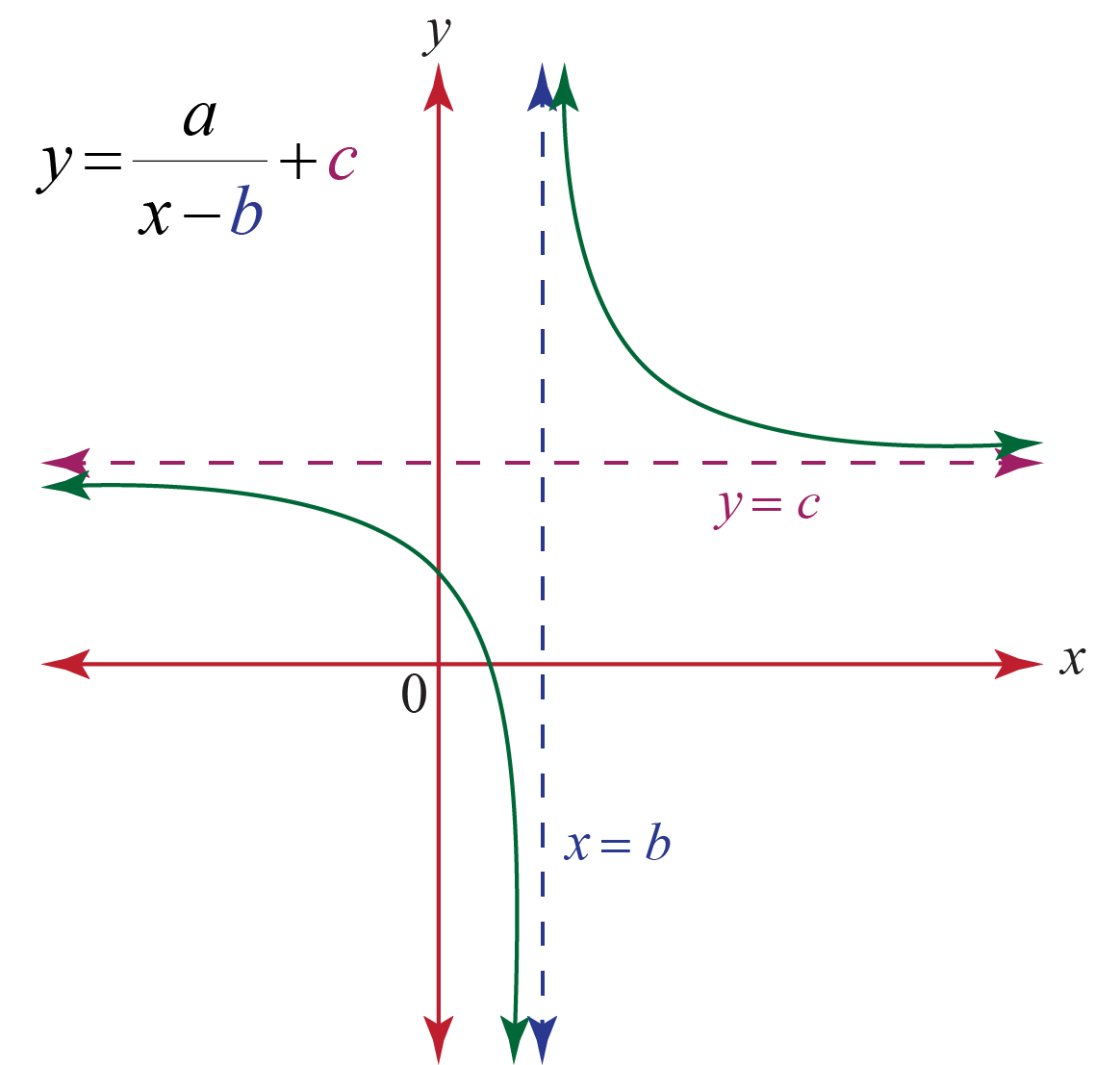

Understanding the intricacies of a Parent Rational Function is crucial for anyone delving into the world of mathematics, particularly in the realm of calculus and algebra. A Parent Rational Function is a fundamental concept that serves as a building block for more complex rational functions. By grasping the basics of these functions, students and enthusiasts can better comprehend the behavior and properties of rational expressions, which are ubiquitous in various mathematical applications.
What is a Parent Rational Function?
A Parent Rational Function is the simplest form of a rational function, typically represented as f(x) = 1/x. This function is characterized by its domain, which excludes the point where the denominator is zero, and its range, which spans all real numbers except zero. The graph of a Parent Rational Function exhibits a hyperbola, with asymptotes along the x-axis and y-axis. Understanding this basic form is essential for analyzing more complex rational functions.
Properties of Parent Rational Functions
Parent Rational Functions possess several key properties that make them unique and useful in mathematical analysis:
- Domain and Range: The domain of f(x) = 1/x is all real numbers except zero, while the range is all real numbers except zero.
- Asymptotes: The function has vertical and horizontal asymptotes at x = 0 and y = 0, respectively.
- Symmetry: The graph is symmetric with respect to the origin, making it an odd function.
- Behavior at Infinity: As x approaches positive or negative infinity, the function approaches zero.
These properties provide a foundation for understanding the behavior of more complex rational functions.
Graphing Parent Rational Functions
Graphing a Parent Rational Function involves plotting points and identifying the asymptotes. Here are the steps to graph f(x) = 1/x:
- Identify the vertical asymptote at x = 0.
- Identify the horizontal asymptote at y = 0.
- Plot points for various values of x, ensuring to avoid x = 0.
- Connect the points with a smooth curve, approaching the asymptotes but never touching them.
📝 Note: When graphing, it's important to choose a range of x-values that clearly show the behavior of the function near the asymptotes.
Transformations of Parent Rational Functions
Understanding transformations is crucial for analyzing more complex rational functions. Transformations of a Parent Rational Function can include horizontal and vertical shifts, reflections, and stretches. These transformations can be applied to the basic function f(x) = 1/x to create a variety of rational functions.
Horizontal and Vertical Shifts
Horizontal shifts are achieved by adding or subtracting a constant from the x-value inside the function. For example, f(x) = 1/(x - h) shifts the graph horizontally by h units. Vertical shifts are achieved by adding or subtracting a constant from the function itself. For example, f(x) = 1/x + k shifts the graph vertically by k units.
Reflections
Reflections can be achieved by multiplying the function by -1. For example, f(x) = -1/x reflects the graph across the x-axis. Similarly, multiplying the x-value inside the function by -1 reflects the graph across the y-axis.
Stretches and Compressions
Stretches and compressions are achieved by multiplying the function by a constant. For example, f(x) = a/x stretches or compresses the graph vertically by a factor of a. Similarly, multiplying the x-value inside the function by a constant stretches or compresses the graph horizontally.
Applications of Parent Rational Functions
Parent Rational Functions have numerous applications in various fields, including physics, engineering, and economics. Some common applications include:
- Physics: Rational functions are used to model physical phenomena such as the behavior of springs, electrical circuits, and fluid dynamics.
- Engineering: In engineering, rational functions are used to analyze systems and design components that exhibit rational behavior.
- Economics: In economics, rational functions are used to model supply and demand curves, cost functions, and other economic relationships.
These applications highlight the versatility and importance of Parent Rational Functions in real-world scenarios.
Examples of Parent Rational Functions
Let's explore a few examples of Parent Rational Functions and their transformations:
Example 1: Basic Parent Rational Function
The basic Parent Rational Function is f(x) = 1/x. This function has a vertical asymptote at x = 0 and a horizontal asymptote at y = 0. The graph is a hyperbola that approaches the asymptotes but never touches them.
Example 2: Horizontal Shift
Consider the function f(x) = 1/(x - 2). This function is a horizontal shift of the basic Parent Rational Function by 2 units to the right. The vertical asymptote is now at x = 2, and the horizontal asymptote remains at y = 0.
Example 3: Vertical Shift
Consider the function f(x) = 1/x + 3. This function is a vertical shift of the basic Parent Rational Function by 3 units upwards. The vertical asymptote remains at x = 0, and the horizontal asymptote is now at y = 3.
Example 4: Reflection and Stretch
Consider the function f(x) = -2/x. This function is a reflection across the x-axis and a vertical stretch by a factor of 2. The vertical asymptote remains at x = 0, and the horizontal asymptote is at y = 0.
Common Mistakes and Pitfalls
When working with Parent Rational Functions, it's important to avoid common mistakes and pitfalls. Some of these include:
- Forgetting Asymptotes: Always identify the vertical and horizontal asymptotes before graphing the function.
- Incorrect Transformations: Ensure that transformations are applied correctly to avoid misrepresenting the function.
- Domain and Range Errors: Remember that the domain excludes the point where the denominator is zero, and the range excludes zero.
By being aware of these pitfalls, you can accurately analyze and graph Parent Rational Functions.
Advanced Topics in Parent Rational Functions
For those interested in delving deeper into the world of Parent Rational Functions, there are several advanced topics to explore:
- Limits and Continuity: Understanding the limits and continuity of rational functions is crucial for advanced calculus.
- Derivatives and Integrals: Calculating the derivatives and integrals of rational functions is essential for various applications in mathematics and physics.
- Partial Fractions: Decomposing rational functions into partial fractions is a powerful technique for solving integrals and differential equations.
These advanced topics provide a deeper understanding of the behavior and properties of Parent Rational Functions.
Conclusion
Parent Rational Functions are a fundamental concept in mathematics, serving as a building block for more complex rational functions. By understanding the properties, transformations, and applications of these functions, students and enthusiasts can gain a deeper appreciation for the beauty and utility of mathematics. Whether in physics, engineering, or economics, Parent Rational Functions play a crucial role in modeling and analyzing real-world phenomena. By mastering the basics and exploring advanced topics, one can unlock the full potential of these versatile mathematical tools.
Related Terms:
- graphing rational functions example
- rational function parent graph
- what makes a rational function
- graphing rational functions with transformations
- examples of a rational function
- rational functions and their properties