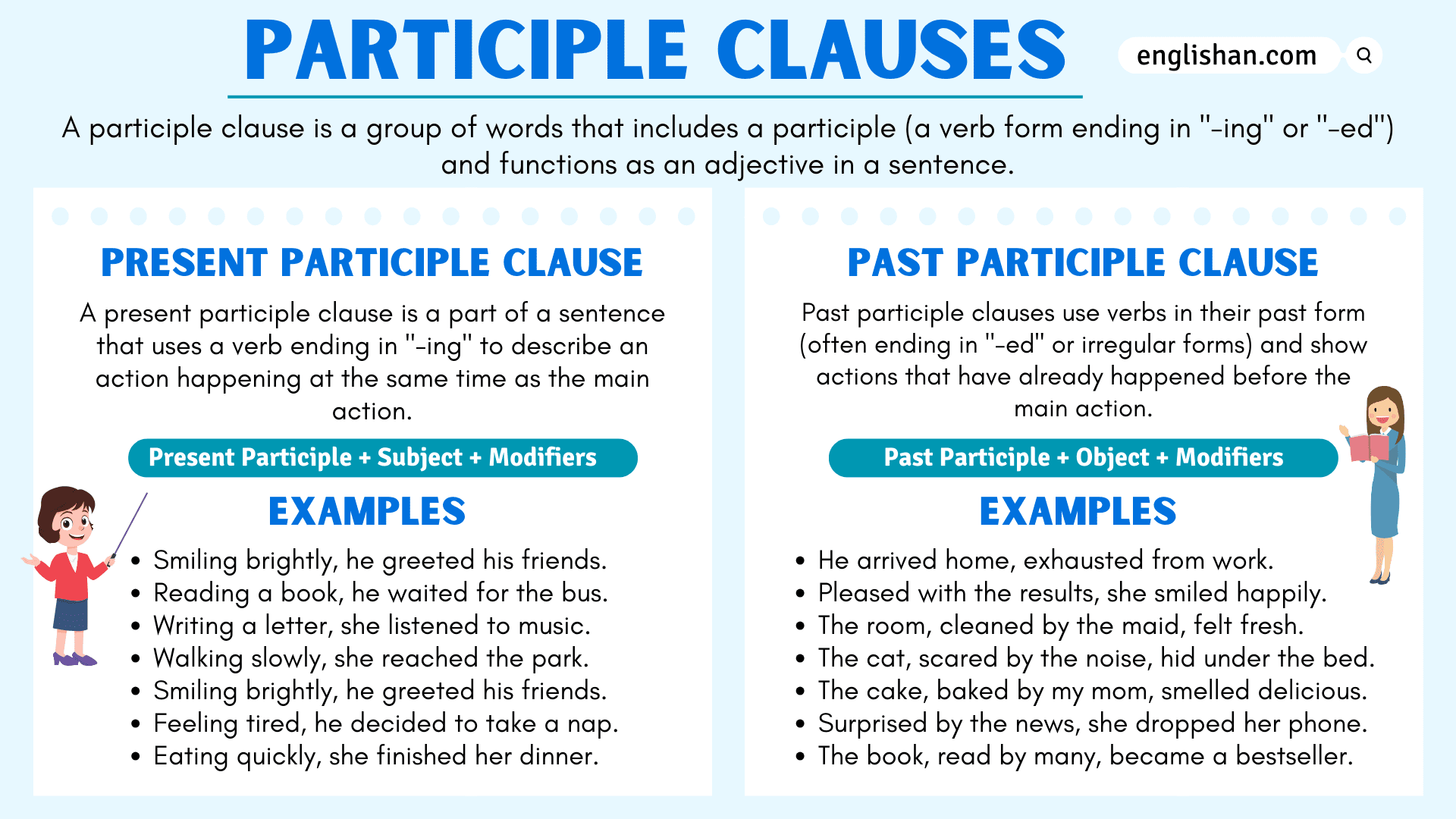

Understanding the nuances of English grammar can significantly enhance your writing and communication skills. One of the most versatile and commonly used verb forms is the present participle. Present participle examples are abundant in everyday language, and mastering their use can make your sentences more dynamic and engaging. This post will delve into the intricacies of present participles, providing clear explanations, examples, and practical tips to help you use them effectively.
What is a Present Participle?
A present participle is a verb form that ends in “-ing.” It is used to create continuous tenses, such as the present continuous and past continuous, and can also function as an adjective or a noun. Understanding how to use present participles correctly can greatly enhance the clarity and flow of your writing.
Present Participle Examples in Sentences
Let’s start with some basic present participle examples to illustrate their usage:
- Present Continuous Tense: “She is reading a book.”
- Past Continuous Tense: “They were playing soccer when it started to rain.”
- As an Adjective: “The barking dog woke me up.”
- As a Noun: “Swimming is my favorite exercise.”
Using Present Participles as Adjectives
Present participles can function as adjectives to describe nouns. This usage adds a dynamic quality to your writing, making it more vivid and engaging. Here are some present participle examples:
- The smiling child brightened everyone’s day.
- The running water soothed her nerves.
- The singing birds filled the air with melody.
Using Present Participles in Continuous Tenses
Present participles are essential for forming continuous tenses, which describe actions happening at the time of speaking or writing. Here are some present participle examples in continuous tenses:
- Present Continuous: “I am writing a blog post.”
- Past Continuous: “She was cooking dinner when I arrived.”
- Future Continuous: “They will be traveling to Europe next summer.”
Present Participles as Nouns
Present participles can also function as nouns, often referring to activities or actions. This usage is common in headlines, titles, and informal writing. Here are some present participle examples:
- Swimming is a great way to stay fit.
- Reading is her favorite hobby.
- Dancing is a form of self-expression.
Present Participles in Complex Sentences
Present participles can be used to create complex sentences by combining two related ideas. This technique can make your writing more concise and fluid. Here are some present participle examples in complex sentences:
- While walking in the park, she saw a beautiful sunset.
- Having finished her homework, she went to play outside.
- Despite raining heavily, we decided to go to the beach.
Common Mistakes with Present Participles
While present participles are versatile, they can also be a source of confusion. Here are some common mistakes to avoid:
- Dangling Participles: A dangling participle occurs when the subject of the sentence is not clear. For example, “After eating the cake, the dishes were washed.” This sentence implies that the dishes ate the cake. To correct it, specify the subject: “After I ate the cake, I washed the dishes.”
- Misplaced Participles: A misplaced participle can create confusion by placing the participle too far from the noun it modifies. For example, “She saw a man running down the street with a dog.” This sentence suggests that the dog was running down the street. To correct it, place the participle closer to the noun it modifies: “She saw a man with a dog running down the street.”
📝 Note: Always ensure that the subject of the sentence is clear when using present participles to avoid dangling or misplaced participles.
Practical Tips for Using Present Participles
Here are some practical tips to help you use present participles effectively:
- Clarity: Ensure that the subject of the sentence is clear to avoid dangling or misplaced participles.
- Conciseness: Use present participles to combine related ideas and make your writing more concise.
- Variety: Vary your sentence structure by using present participles to create complex sentences.
- Practice: Practice using present participles in different contexts to become more comfortable with their usage.
Present Participle Examples in Different Contexts
Present participles can be used in various contexts, from formal writing to casual conversation. Here are some present participle examples in different contexts:
Formal Writing
In formal writing, present participles can add a touch of elegance and sophistication. Here are some present participle examples:
- Having completed her research, she presented her findings to the committee.
- The whispering winds carried the scent of blooming flowers.
- Despite facing numerous challenges, she remained determined to succeed.
Casual Conversation
In casual conversation, present participles can make your speech more dynamic and engaging. Here are some present participle examples:
- I’m going to the store to buy some groceries.
- She’s studying for her exams right now.
- They’re planning a surprise party for their friend.
Literary Works
In literary works, present participles can create vivid imagery and enhance the narrative flow. Here are some present participle examples:
- The rustling leaves whispered secrets to the wind.
- She walked along the shimmering river, lost in thought.
- The howling wind echoed through the empty streets.
Academic Writing
In academic writing, present participles can help clarify complex ideas and improve the flow of your arguments. Here are some present participle examples:
- Having analyzed the data, we concluded that the hypothesis was correct.
- The evolving nature of technology presents new challenges for researchers.
- Despite facing numerous obstacles, the project was completed on time.
Present Participle Examples in Different Tenses
Present participles are used in various tenses to describe actions happening at different times. Here are some present participle examples in different tenses:
| Tense | Example |
|---|---|
| Present Continuous | She is reading a book. |
| Past Continuous | They were playing soccer when it started to rain. |
| Future Continuous | We will be traveling to Europe next summer. |
| Present Perfect Continuous | I have been studying for my exams all week. |
| Past Perfect Continuous | She had been working on the project for months before it was completed. |
| Future Perfect Continuous | By next year, they will have been living in this city for a decade. |
📝 Note: Present participles are essential for forming continuous tenses, which describe actions happening over a period of time.
Present Participle Examples in Idiomatic Expressions
Present participles are also used in idiomatic expressions, which are fixed phrases with meanings that cannot be understood from the literal definition of the words. Here are some present participle examples in idiomatic expressions:
- She’s breaking the ice by telling a joke.
- He’s biting his tongue to avoid saying something he might regret.
- They’re burning the midnight oil to finish the project.
Present Participle Examples in Headlines and Titles
Present participles are commonly used in headlines and titles to create concise and attention-grabbing phrases. Here are some present participle examples in headlines and titles:
- Running for Office: A Guide for First-Time Candidates
- Cooking with Fresh Ingredients: Tips and Recipes
- Swimming for Fitness: Benefits and Techniques
Present participles are a versatile and essential part of English grammar. By understanding how to use them effectively, you can enhance the clarity, flow, and dynamism of your writing. Whether you’re using them as adjectives, nouns, or in continuous tenses, present participles offer a wide range of possibilities for expressing your ideas. With practice and attention to detail, you can master the use of present participles and elevate your writing to new heights.
Related Terms:
- present participle vs gerund
- present participle examples spanish
- past participle
- present participle examples in french
- present participle phrase
- present participle examples pdf