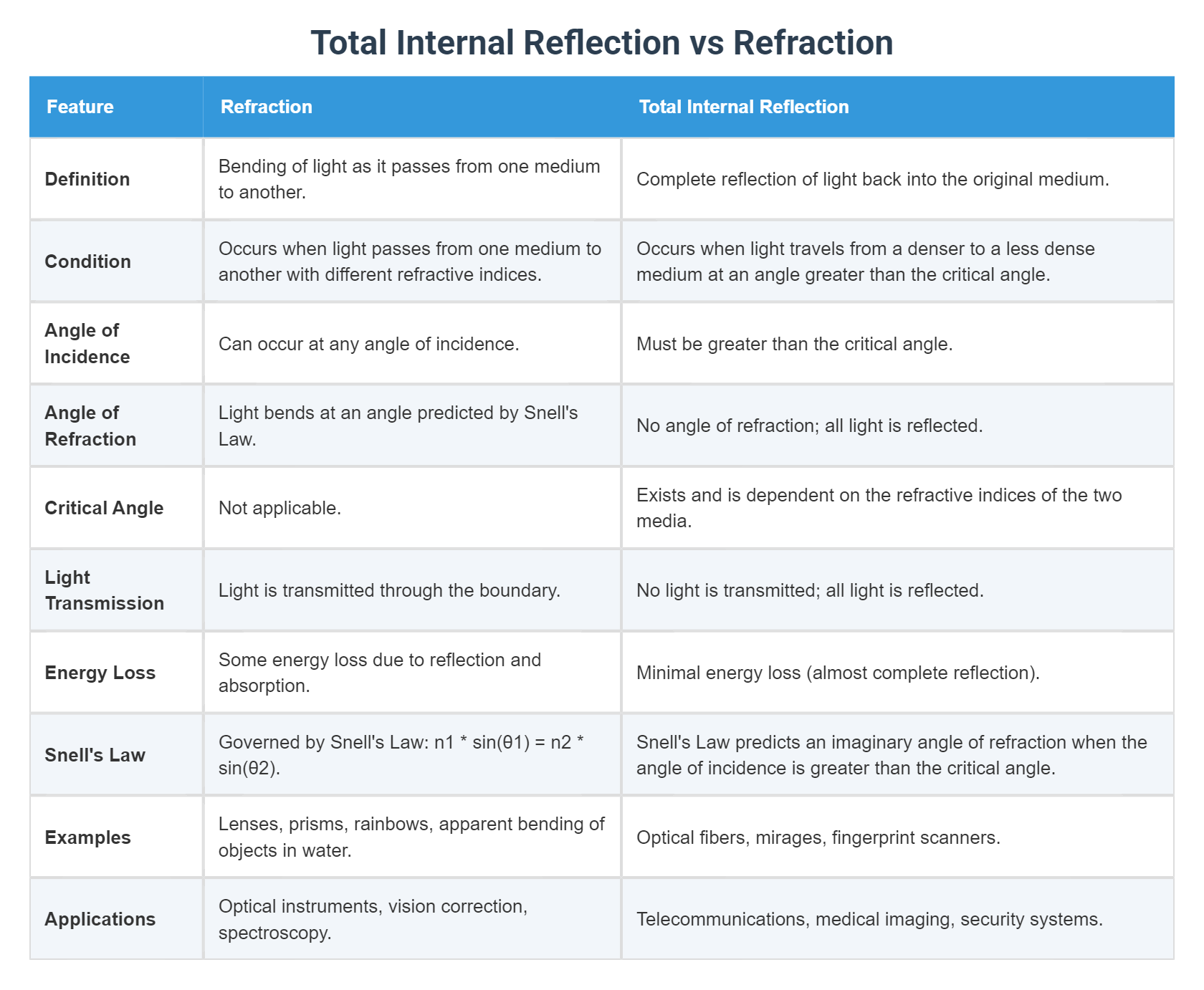

Understanding the principles of light interaction with different surfaces is fundamental in optics. Two key phenomena that govern how light behaves when it encounters a boundary between two media are refraction vs reflection. These concepts are crucial in various fields, including physics, engineering, and everyday applications like lenses, mirrors, and fiber optics. This post delves into the intricacies of refraction vs reflection, explaining their differences, applications, and the underlying physics.
Understanding Reflection
Reflection is the change in direction of a wavefront at an interface between two different media so that the wavefront returns into the medium from which it originated. Common examples include the reflection of light off a mirror or water surface. The law of reflection states that the angle of incidence is equal to the angle of reflection. This principle is essential in designing mirrors and other reflective surfaces.
When light hits a smooth, shiny surface, it bounces back at the same angle it hit the surface. This is known as specular reflection. In contrast, diffuse reflection occurs when light hits a rough surface and scatters in many directions. Understanding these types of reflection is crucial for applications like photography, where controlling light reflection can enhance image quality.
Understanding Refraction
Refraction, on the other hand, is the bending of a wave when it enters a medium where its speed is different. The most common example is when light passes from air into water or glass. The amount of bending depends on the refractive indices of the two media. The refractive index is a measure of how much the speed of light is reduced inside the medium.
When light travels from a less dense medium (like air) to a denser medium (like water), it bends towards the normal (an imaginary line perpendicular to the surface). Conversely, when light travels from a denser medium to a less dense medium, it bends away from the normal. This phenomenon is described by Snell's Law, which relates the angles of incidence and refraction to the refractive indices of the two media.
Key Differences Between Refraction vs Reflection
While both refraction and reflection involve the interaction of light with a surface, they differ in several key ways:
- Direction of Light: In reflection, light bounces back into the same medium, while in refraction, light bends and continues into the new medium.
- Angle of Incidence vs. Angle of Refraction: The angle of incidence is equal to the angle of reflection in reflection. In refraction, the angle of incidence and the angle of refraction are related by Snell's Law.
- Applications: Reflection is used in mirrors, telescopes, and periscopes. Refraction is used in lenses, prisms, and fiber optics.
Applications of Reflection
Reflection has numerous practical applications:
- Mirrors: Used in everyday life for personal grooming, in scientific instruments like telescopes, and in architecture for decorative purposes.
- Optical Instruments: Reflecting telescopes use mirrors to gather and focus light, providing clear images of distant objects.
- Safety and Signaling: Reflective materials are used in road signs, safety vests, and vehicle reflectors to enhance visibility and safety.
Applications of Refraction
Refraction is equally important in various fields:
- Lenses: Used in eyeglasses, cameras, and microscopes to correct vision and magnify objects.
- Prisms: Used to disperse light into its constituent colors, as seen in rainbows and spectroscopic analysis.
- Fiber Optics: Used in telecommunications to transmit data over long distances with minimal loss.
The Physics Behind Refraction vs Reflection
The physics behind refraction and reflection can be understood through the principles of wave theory and the behavior of light. When light hits a surface, it interacts with the atoms and molecules of the material. In reflection, the light wave bounces back due to the interaction with the surface atoms. In refraction, the light wave changes speed as it enters a new medium, causing it to bend.
Snell's Law, which governs refraction, is mathematically expressed as:
📝 Note: The formula for Snell's Law is n1 * sin(θ1) = n2 * sin(θ2), where n1 and n2 are the refractive indices of the two media, and θ1 and θ2 are the angles of incidence and refraction, respectively.
This law is crucial in designing optical systems and understanding how light behaves in different media.
Real-World Examples of Refraction vs Reflection
To better understand the concepts of refraction vs reflection, let's look at some real-world examples:
- Mirror Image: When you look into a mirror, you see your reflection. This is an example of specular reflection, where the light bounces back at the same angle it hit the surface.
- Rainbow Formation: A rainbow is formed due to the refraction and reflection of light in raindrops. Light enters a raindrop, refracts, reflects off the inner surface, and then refracts again as it exits, separating into its constituent colors.
- Lens Focus: In a camera, the lens uses refraction to focus light onto the sensor, creating a clear image. The shape and refractive index of the lens determine how the light bends and focuses.
These examples illustrate how refraction vs reflection are integral to our daily experiences and technological advancements.
Experimental Demonstrations
To further illustrate the concepts of refraction vs reflection, consider the following experiments:
- Reflection Experiment: Place a mirror in a dark room and shine a laser pointer at it. Observe the angle of incidence and the angle of reflection. You will notice that they are equal, confirming the law of reflection.
- Refraction Experiment: Fill a glass with water and place a coin at the bottom. Slowly move your head to the side while looking at the coin. You will see the coin appear to move due to the refraction of light as it passes from water to air.
These simple experiments can help visualize the principles of refraction vs reflection and their practical applications.
📝 Note: Always ensure safety when conducting experiments with lasers or other optical devices.
Advanced Topics in Refraction vs Reflection
For those interested in delving deeper into the subject, advanced topics include:
- Total Internal Reflection: This occurs when light travels from a denser medium to a less dense medium and the angle of incidence is greater than the critical angle. The light is completely reflected back into the denser medium, which is the principle behind fiber optics.
- Diffraction and Interference: These phenomena occur when light waves interact with each other or with obstacles, leading to complex patterns of light and dark areas. Understanding these concepts is crucial in fields like holography and spectroscopy.
These advanced topics build on the fundamental principles of refraction vs reflection and open up a world of complex optical phenomena and applications.
Conclusion
In summary, understanding the principles of refraction vs reflection is essential for grasping how light interacts with different surfaces and media. Reflection involves the bouncing back of light, governed by the law of reflection, while refraction involves the bending of light, described by Snell’s Law. Both phenomena have wide-ranging applications in optics, from mirrors and lenses to fiber optics and telescopes. By exploring real-world examples and conducting simple experiments, one can gain a deeper appreciation for these fundamental optical principles and their impact on our daily lives and technological advancements.
Related Terms:
- reflection vs refraction definition
- reflection vs refraction of light
- reflection and refraction
- reflection vs refraction vs diffraction
- reflection and refraction definition
- reflection vs refraction one pager