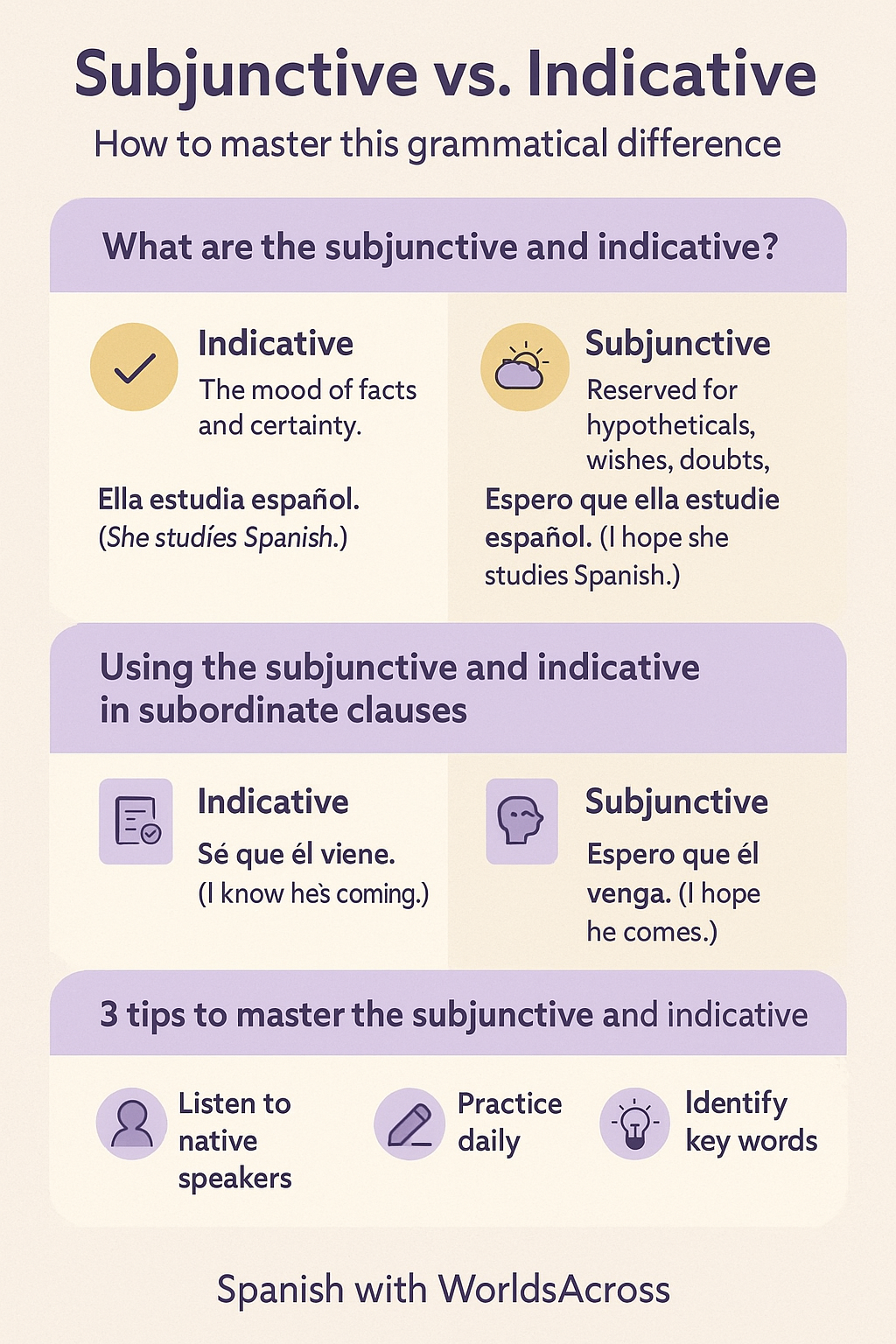

Learning Spanish can be an exciting journey, filled with the rich culture and history of the Spanish-speaking world. One of the most intriguing aspects of the Spanish language is its use of different moods, particularly the Subjunctive Vs Indicative Spanish. Understanding the difference between these two moods is crucial for mastering the language, as they serve distinct purposes and convey different nuances in communication.
Understanding the Indicative Mood
The indicative mood is used to express facts, opinions, and certainties. It is the most commonly used mood in Spanish and is essential for everyday communication. The indicative mood can be further divided into several tenses, each serving a specific purpose.
Present Tense
The present tense in the indicative mood is used to describe actions happening now, general truths, and habitual actions. For example:
- Yo hablo español. (I speak Spanish.)
- Ella vive en Madrid. (She lives in Madrid.)
- Nosotros comemos a las siete. (We eat at seven.)
Preterite Tense
The preterite tense is used to describe completed actions in the past. It is often used to narrate events or describe what happened at a specific time. For example:
- Yo comí una pizza anoche. (I ate a pizza last night.)
- Ella estudió mucho para el examen. (She studied a lot for the exam.)
- Nosotros viajamos a México el año pasado. (We traveled to Mexico last year.)
Imperfect Tense
The imperfect tense is used to describe ongoing or habitual actions in the past, as well as to set the scene for a story. It is often used to describe what was happening at a specific time in the past. For example:
- Yo estudiaba español todos los días. (I studied Spanish every day.)
- Ella vivía en Barcelona cuando era joven. (She lived in Barcelona when she was young.)
- Nosotros comíamos juntos todos los fines de semana. (We ate together every weekend.)
Understanding the Subjunctive Mood
The subjunctive mood is used to express doubts, wishes, emotions, and hypothetical situations. It is less commonly used than the indicative mood but is essential for expressing nuanced thoughts and feelings. The subjunctive mood can also be divided into several tenses, each serving a specific purpose.
Present Subjunctive
The present subjunctive is used to express desires, doubts, and emotions in the present or future. It is often used after expressions that indicate uncertainty or emotion. For example:
- Espero que hable español. (I hope that he speaks Spanish.)
- Dudo que venga a la fiesta. (I doubt that he will come to the party.)
- Es importante que estudies mucho. (It is important that you study a lot.)
Imperfect Subjunctive
The imperfect subjunctive is used to express wishes, doubts, and hypothetical situations in the past. It is often used in subordinate clauses introduced by "si" (if) or other conjunctions that indicate uncertainty. For example:
- Ojalá hubiera estudiado más. (I wish I had studied more.)
- Si hubiera sabido, te lo habría dicho. (If I had known, I would have told you.)
- Dudaba que viniera a la fiesta. (I doubted that he would come to the party.)
Subjunctive Vs Indicative Spanish: Key Differences
Understanding the key differences between the subjunctive and indicative moods is essential for mastering Subjunctive Vs Indicative Spanish. Here are some of the main differences:
- Purpose: The indicative mood is used to express facts and certainties, while the subjunctive mood is used to express doubts, wishes, and hypothetical situations.
- Usage: The indicative mood is more commonly used in everyday communication, while the subjunctive mood is used in more specific contexts, such as expressing emotions or uncertainties.
- Tenses: Both moods have several tenses, each serving a specific purpose. The indicative mood includes the present, preterite, and imperfect tenses, among others, while the subjunctive mood includes the present and imperfect subjunctive tenses, among others.
To further illustrate the differences, consider the following examples:
| Indicative Mood | Subjunctive Mood |
|---|---|
| Yo creo que él viene a la fiesta. (I believe that he is coming to the party.) | Yo creo que él venga a la fiesta. (I believe that he comes to the party.) |
| Ella dice que está cansada. (She says that she is tired.) | Ella dice que esté cansada. (She says that she is tired.) |
| Nosotros sabemos que llueve mucho en España. (We know that it rains a lot in Spain.) | Nosotros sabemos que llueva mucho en España. (We know that it rains a lot in Spain.) |
As you can see, the indicative mood is used to express facts and certainties, while the subjunctive mood is used to express doubts, wishes, and hypothetical situations. Understanding these differences is crucial for mastering Subjunctive Vs Indicative Spanish.
💡 Note: The subjunctive mood can be challenging for English speakers because it does not have a direct equivalent in English. However, with practice and exposure to the language, it becomes more intuitive.
When to Use the Subjunctive Mood
Knowing when to use the subjunctive mood is essential for effective communication in Spanish. Here are some common situations where the subjunctive mood is used:
- Expressing Emotions: The subjunctive mood is often used to express emotions such as hope, fear, or doubt. For example:
Espero que hable español. (I hope that he speaks Spanish.)
- Expressing Doubts: The subjunctive mood is used to express doubts or uncertainties about a situation. For example:
Dudo que venga a la fiesta. (I doubt that he will come to the party.)
- Expressing Wishes: The subjunctive mood is used to express wishes or desires. For example:
Ojalá hubiera estudiado más. (I wish I had studied more.)
- Hypothetical Situations: The subjunctive mood is used to express hypothetical situations or conditions. For example:
Si hubiera sabido, te lo habría dicho. (If I had known, I would have told you.)
Understanding these situations will help you determine when to use the subjunctive mood in your Spanish communication.
💡 Note: The subjunctive mood is often used in subordinate clauses introduced by conjunctions such as "que" (that), "si" (if), or "para que" (so that). Paying attention to these conjunctions can help you identify when to use the subjunctive mood.
Practice Exercises for Subjunctive Vs Indicative Spanish
Practicing Subjunctive Vs Indicative Spanish is essential for mastering the language. Here are some exercises to help you improve your understanding and usage of these moods:
Exercise 1: Fill in the Blanks
Fill in the blanks with the correct form of the verb in either the indicative or subjunctive mood.
- Yo creo que él __________ a la fiesta. (I believe that he is coming to the party.)
- Ella dice que __________ cansada. (She says that she is tired.)
- Nosotros sabemos que __________ mucho en España. (We know that it rains a lot in Spain.)
- Espero que __________ español. (I hope that he speaks Spanish.)
- Dudo que __________ a la fiesta. (I doubt that he will come to the party.)
Exercise 2: Translate Sentences
Translate the following sentences from English to Spanish, using the correct mood (indicative or subjunctive).
- I believe that she is coming to the party.
- She says that she is tired.
- We know that it rains a lot in Spain.
- I hope that he speaks Spanish.
- I doubt that he will come to the party.
Practicing these exercises will help you improve your understanding and usage of the indicative and subjunctive moods in Spanish.
💡 Note: Regular practice is key to mastering Subjunctive Vs Indicative Spanish. Incorporate these exercises into your daily study routine to see significant improvement.
Mastering Subjunctive Vs Indicative Spanish is a crucial step in becoming proficient in the language. By understanding the differences between these two moods and practicing their usage, you will be able to express yourself more accurately and effectively in Spanish. Whether you are a beginner or an advanced learner, focusing on these moods will enhance your communication skills and deepen your appreciation for the Spanish language.
Related Terms:
- indicative vs subjunctive practice spanish
- subjunctive vs indicative spanish exercises
- subjunctive or indicative spanish practice
- indicative vs subjunctive chart
- subjunctive vs indicative spanish dictionary
- indicative vs subjunctive spanish examples