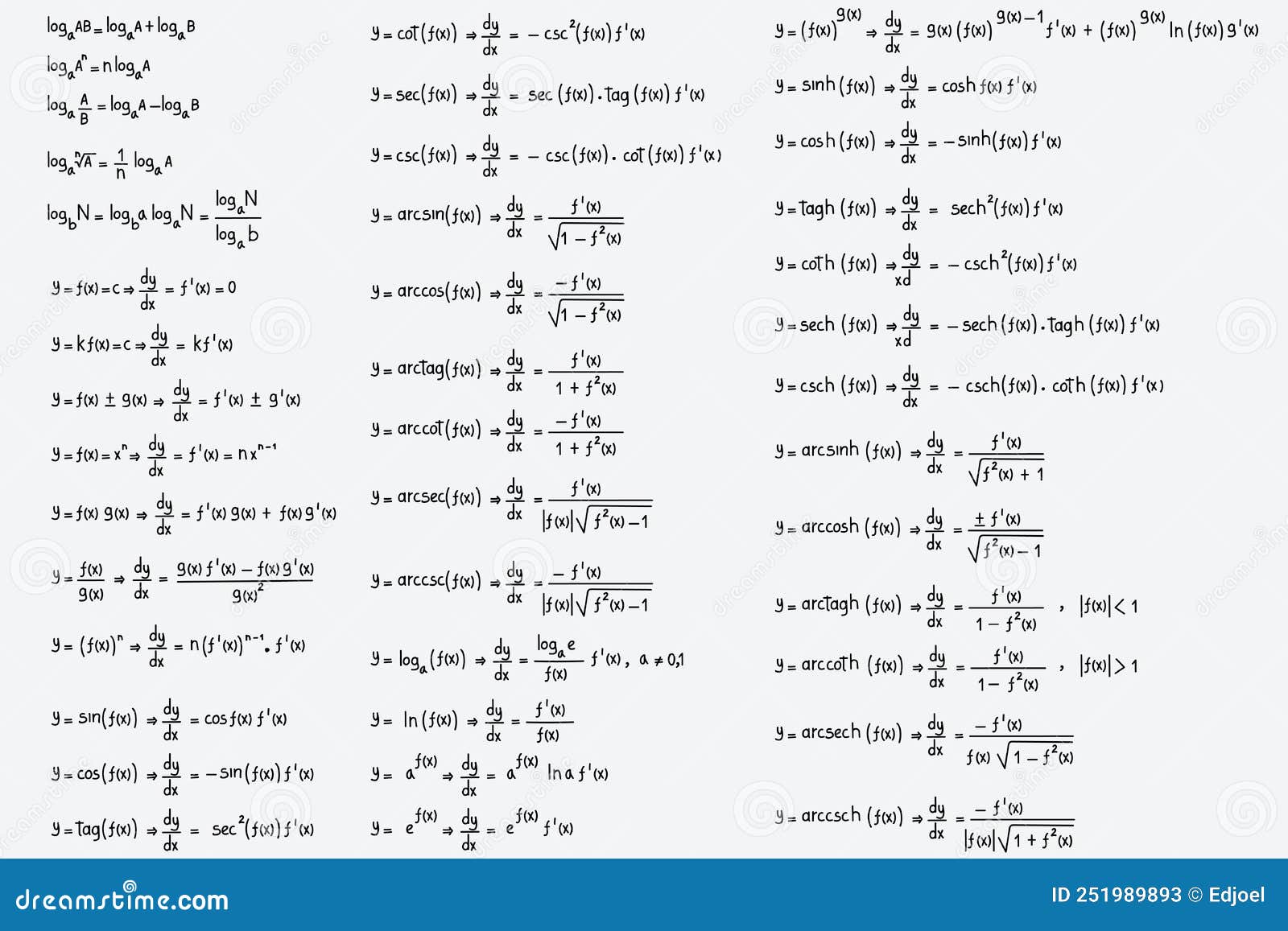

Understanding trigonometric functions and their derivatives is crucial for anyone studying calculus or advanced mathematics. Trig function differentiation involves finding the rate at which trigonometric functions change with respect to their variables. This process is fundamental in various fields, including physics, engineering, and computer graphics. This blog post will delve into the basics of trigonometric functions, their derivatives, and practical applications.
Understanding Trigonometric Functions
Trigonometric functions are essential in mathematics and are used to model periodic phenomena. The primary trigonometric functions are sine (sin), cosine (cos), and tangent (tan). These functions are defined for angles in a right triangle or on the unit circle. Understanding these functions is the first step in mastering trig function differentiation.
Basic Trigonometric Functions
The three basic trigonometric functions are:
- Sine (sin): Defined as the ratio of the opposite side to the hypotenuse in a right triangle.
- Cosine (cos): Defined as the ratio of the adjacent side to the hypotenuse in a right triangle.
- Tangent (tan): Defined as the ratio of the opposite side to the adjacent side in a right triangle.
Derivatives of Trigonometric Functions
To perform trig function differentiation, you need to know the derivatives of the basic trigonometric functions. Here are the derivatives of sine, cosine, and tangent:
- Derivative of sine (sin): The derivative of sin(x) is cos(x).
- Derivative of cosine (cos): The derivative of cos(x) is -sin(x).
- Derivative of tangent (tan): The derivative of tan(x) is sec²(x).
These derivatives are derived using the limit definition of a derivative and the unit circle. Understanding these derivatives is crucial for solving problems involving trig function differentiation.
Derivatives of Other Trigonometric Functions
In addition to the basic trigonometric functions, there are other functions like cosecant (csc), secant (sec), and cotangent (cot). Their derivatives are also important in trig function differentiation. Here are their derivatives:
- Derivative of cosecant (csc): The derivative of csc(x) is -csc(x)cot(x).
- Derivative of secant (sec): The derivative of sec(x) is sec(x)tan(x).
- Derivative of cotangent (cot): The derivative of cot(x) is -csc²(x).
These derivatives can be derived using the quotient rule and the derivatives of the basic trigonometric functions.
Applications of Trig Function Differentiation
Trig function differentiation has numerous applications in various fields. Here are a few examples:
- Physics: Trigonometric functions are used to model wave motion, circular motion, and harmonic oscillators. Differentiating these functions helps in finding velocities, accelerations, and other rates of change.
- Engineering: In mechanical and electrical engineering, trigonometric functions are used to analyze signals, circuits, and mechanical systems. Differentiating these functions helps in understanding the behavior of these systems.
- Computer Graphics: Trigonometric functions are used to model rotations, translations, and other transformations in computer graphics. Differentiating these functions helps in creating smooth animations and realistic simulations.
Practical Examples
Let’s look at a few practical examples of trig function differentiation.
Example 1: Finding the Derivative of sin(2x)
To find the derivative of sin(2x), we use the chain rule. The derivative of sin(u) is cos(u), and the derivative of 2x is 2. Therefore, the derivative of sin(2x) is:
d/dx [sin(2x)] = cos(2x) * 2 = 2cos(2x)
Example 2: Finding the Derivative of cos(3x)
To find the derivative of cos(3x), we again use the chain rule. The derivative of cos(u) is -sin(u), and the derivative of 3x is 3. Therefore, the derivative of cos(3x) is:
d/dx [cos(3x)] = -sin(3x) * 3 = -3sin(3x)
Example 3: Finding the Derivative of tan(x²)
To find the derivative of tan(x²), we use the chain rule. The derivative of tan(u) is sec²(u), and the derivative of x² is 2x. Therefore, the derivative of tan(x²) is:
d/dx [tan(x²)] = sec²(x²) * 2x = 2xsec²(x²)
💡 Note: When differentiating trigonometric functions, always remember to use the chain rule if the function is composed of other functions.
Trigonometric Identities and Differentiation
Trigonometric identities are equations that are true for all values of the variables. These identities can be very useful in trig function differentiation. Here are a few important identities:
- Pythagorean Identity: sin²(x) + cos²(x) = 1
- Double Angle Identity: sin(2x) = 2sin(x)cos(x)
- Sum of Angles Identity: sin(x + y) = sin(x)cos(y) + cos(x)sin(y)
These identities can be used to simplify trigonometric expressions before differentiating them. For example, if you have the function sin(x)cos(x), you can use the double angle identity to rewrite it as sin(2x)/2 before differentiating.
Implicit Differentiation with Trigonometric Functions
Implicit differentiation is a technique used to differentiate implicit functions, which are functions defined by an equation where the dependent variable is not explicitly expressed in terms of the independent variable. Trig function differentiation often involves implicit differentiation. Here’s an example:
Consider the equation sin(xy) = x. To find dy/dx, we differentiate both sides with respect to x, treating y as a function of x:
d/dx [sin(xy)] = d/dx [x]
cos(xy) * (y + xy') = 1
Now, solve for y':
y' = (1 - cos(xy)y) / (xcos(xy))
💡 Note: When performing implicit differentiation with trigonometric functions, always remember to use the chain rule and product rule as needed.
Second Derivatives of Trigonometric Functions
Sometimes, you need to find the second derivative of a trigonometric function. This involves differentiating the first derivative. Here are the second derivatives of the basic trigonometric functions:
- Second derivative of sine (sin): The second derivative of sin(x) is -sin(x).
- Second derivative of cosine (cos): The second derivative of cos(x) is -cos(x).
- Second derivative of tangent (tan): The second derivative of tan(x) is 2sec²(x)tan(x).
These second derivatives can be derived by differentiating the first derivatives.
Higher-Order Derivatives of Trigonometric Functions
You can also find higher-order derivatives of trigonometric functions by repeatedly differentiating. Here’s a table showing the first few derivatives of sine, cosine, and tangent:
| Function | First Derivative | Second Derivative | Third Derivative | Fourth Derivative |
|---|---|---|---|---|
| sin(x) | cos(x) | -sin(x) | -cos(x) | sin(x) |
| cos(x) | -sin(x) | -cos(x) | sin(x) | cos(x) |
| tan(x) | sec²(x) | 2sec²(x)tan(x) | 2sec⁴(x) + 4sec²(x)tan²(x) | 8sec⁴(x)tan(x) + 8sec²(x)tan³(x) |
Notice that the derivatives of sine and cosine repeat every four derivatives. This is a property of periodic functions.
💡 Note: Higher-order derivatives of trigonometric functions can become quite complex. It's important to practice and understand the patterns that emerge.
In the realm of trig function differentiation, understanding the derivatives of trigonometric functions is just the beginning. These derivatives are used in various applications, from physics and engineering to computer graphics and beyond. By mastering these concepts, you'll be well-equipped to tackle more advanced topics in calculus and mathematics.
In conclusion, trig function differentiation is a fundamental concept in calculus that has wide-ranging applications. By understanding the derivatives of trigonometric functions and practicing with examples, you can build a strong foundation in this area. Whether you’re studying for an exam, working on a project, or simply exploring mathematics, mastering trig function differentiation will serve you well.
Related Terms:
- differentiating sin cos and tan
- differentiating trig identities
- differentiation table of trigonometry
- differentiating trig functions formula
- sin cos differentiation circle
- differentiation from first principles trig